How AI Is Learning to Write, Paint and Think
TL;DR:
AI creativity exists in three tiers: exploratory (finding patterns in existing styles), combinatorial (mixing known elements), and transformational (creating genuinely new forms). In 2026, generative tools are strongest when humans set intent, curate outputs, document edits, and avoid unlicensed imitation.
Academy review: October 6, 2026
Model names and capabilities change frequently. We use provider families (GPT, Claude, Gemini) in Academy copy — verify current tiers on provider sites or our LLM Model Family Guide.
For live model picks, cross-check with our AI Image Generation guide.
October 2026 update: creative control matters more than prompt cleverness
Modern image, video, music, and writing models make exploratory and combinatorial creativity much faster. The durable question is human authorship: what did you choose, arrange, edit, reject, and make meaningful?
For commercial work, document your creative inputs and avoid prompts that merely imitate living artists or copyrighted house styles unless you have permission. The U.S. Copyright Office's 2025 AI report confirms that AI assistance does not bar copyright protection for human-authored contributions, but prompts alone are weak evidence of authorship.
Primary source: U.S. Copyright Office Part 2 announcement. For the legal companion, see AI & The Law.
Author: Marcus du Sautoy (Simonyi Professor, University of Oxford)
Published: 2019 • Length: ~420 pages • Read Time: 6-7 hours
Awards: Longlisted for several major science writing awards
Central Question: Can artificial intelligence be truly creative? Or will it always be merely a tool reflecting human creativity back to us?
Why This Matters
Lovelace test — 2026 reading note
Can machines originate novelty or only recombine? Still the right question before “AI artist” claims.
Ada Lovelace (1815-1852), the world's first computer programmer, believed machines could never transcend their programming. The Lovelace Test asks: Can an algorithm produce something truly creative?
Not in training data
Genuinely novel or recombination?
Example: Move 37 never appeared in Go history
Unexpected to experts
Contradicts intuition?
Example: Move 37 looked wrong yet won
Meaningful to humans
Genuine value beyond novelty?
Example: Move 37 was beautiful and strategic
The Verdict
Three types — 2026 reading note
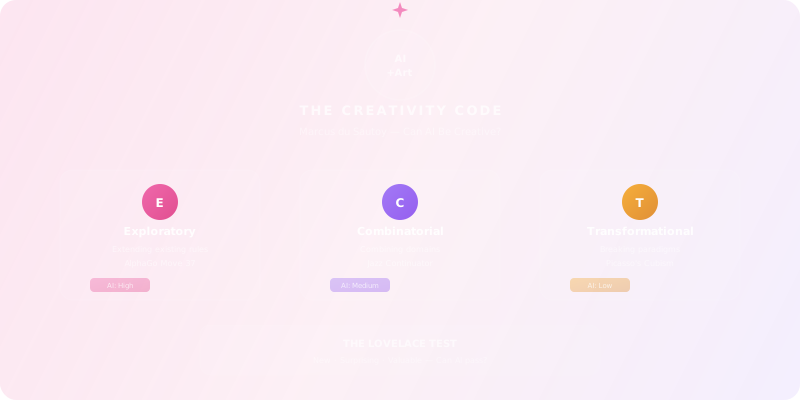
Exploratory, combinatorial, transformational — different tools shine on each; don’t expect one model for all.
Core Framework
Extending existing rules. AI excels here.
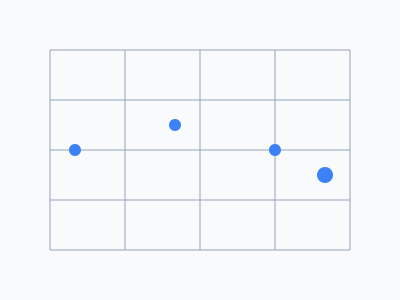
Key Example: AlphaGo Move 37—surprising yet valid within Go rules
Combining different domains. AI shows moderate capability.
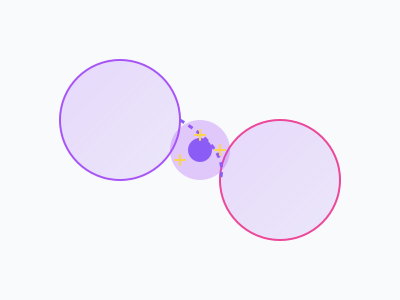
Key Example: Jazz Continuator—helped Bernard Lubat be more creative
Breaking rules entirely. Remains distinctly human.
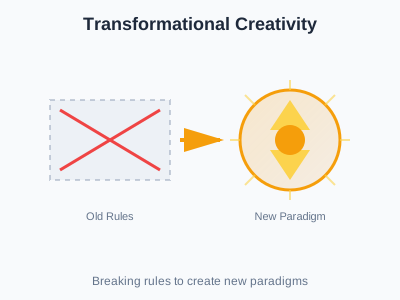
Key Example: Picasso's Cubism, Schoenberg's atonality—paradigm shifts
Breakthrough moments — 2026 reading note
Human breakthroughs combine constraint, play, and domain mastery — AI accelerates combinatorics, not always taste.
March 2016 • Game 2 vs. Lee Sedol
In March 2016, Google's AlphaGo defeated world champion Lee Sedol. In game 2, Move 37 shocked everyone:
The Lovelace Test Moment
Sony CSL • Bernard Lubat Collaboration
Revolutionary example: AI trained on jazz musician Bernard Lubat's improvisations, then performed with him in call-and-response concert.
Bernard Lubat's Reaction:
"It's undeniably me—my sound world—but it's doing things I never thought of. The AI helped me be more creative."
Key Insight
Microsoft + Delft University • 2016
Project analyzed Rembrandt's 346 paintings in microscopic detail: geometry, composition, lighting, materials. Then generated a "new" Rembrandt painting (3D printed in 13 layers of paint-based ink).
✅ Achieved:
Visually convincing Rembrandt-esque painting combining his techniques
❓ Question:
Is it creative or derivative? Does knowing HOW it was made change your experience?
Du Sautoy's Analysis
Across domains — 2026 reading note
Music, art, writing — each has different copyright and authenticity norms post-2023 generators.
Key Insight
Example:
AlphaGo Move 37
Challenge:
Moving beyond optimal play to creative play
Example:
Jazz Continuator, AIVA
Challenge:
Avoiding formula while achieving originality
Example:
Diffusion image models, Next Rembrandt
Challenge:
Creating meaning, authorship, and non-derivative direction — not just polished images
Example:
LLM drafting, editing, ideation
Challenge:
Capturing human meaning, voice, accountability, and emotional truth
Example:
Automated theorem proving
Challenge:
Transformational breakthroughs like imaginary numbers
Example:
Text-to-video and generative editing
Challenge:
Continuity, intent, rights clearance, and coherent storytelling
Consciousness — 2026 reading note
Philosophical debate with product impact: if it isn’t conscious, don’t outsource moral agency to it.
What would it take for AI to be truly creative?
Du Sautoy argues: Until a machine becomes conscious, it cannot be more than a tool for extending human creativity. But when consciousness emerges (and he believes it might), then machines will "want to tell us what it's like"—and that's when true machine creativity begins.
Interestingly, du Sautoy argues conscious AI might be our salvation. Why? Because conscious beings understand other perspectives. A conscious AI would:
The Philosophical Frontier
For creatives — 2026 reading note
Practitioners: AI as sketch partner, not brand author — style boards and review gates win.
How to position yourself in the age of creative AI
Use AI as creative partner, not replacement
Let AI push you outside comfort zones
Keep humans in creative decision-making, selection, editing, and approval roles
Use style ingredients and licensed references instead of copying living artists or protected house styles
The Future of Creativity
The three types of creativity are timeless
Try these AI tools to apply the concepts you've just learned
Still insightful on creativity vs. combinatorics — excellent before our Image Generation and Multimodal courses.
Strengths
Limitations
Discussion questions
Next on Academy: AI Image Generation Mastery
AI creativity exists in three tiers: exploratory creativity finds patterns in existing styles, combinatorial creativity mixes known elements in new ways, and transformational creativity creates genuinely new forms—but true creativity requires human judgment, context, and meaning that AI lacks.
Understanding AI's creative capabilities helps you use creative AI tools effectively: recognize when AI is exploring, combining, or transforming, appreciate the role of human curation and interpretation, and leverage AI as a creative collaborator rather than replacement for human creativity.
Apply creative AI tools wisely by combining AI generation with human judgment: use AI for ideation and exploration, apply human taste and context for selection and refinement, document your creative contribution, and avoid unlicensed imitation of living artists or protected house styles.
Complete this quiz to test your understanding of AI creativity and du Sautoy's framework.
Loading quiz...
Know these before you go further.
Narrative books persuade with stories; they are not peer-reviewed capability benchmarks.
What this means for you
Extract frameworks, then validate claims against primary sources and your own pilots.
Books lag model releases by 12–24 months — tactics may predate agents, RAG, and new regulations.
What this means for you
Pair each book with a current Academy guide (security, law, or agents) before operational decisions.
Success stories hide failed deployments, reverted pilots, and hidden labor costs.
What this means for you
Ask “what would falsify this claim?” and run a small experiment before scaling.
A single worldview can anchor team strategy without diversity of risk perspectives.
What this means for you
Read contrasting book-club titles (optimist vs. critic) and document disagreements explicitly.
