Technology, Power, and the 21st Century's Greatest Dilemma
TL;DR:
The coming wave of AI and synthetic biology is uniquely dangerous due to four features: asymmetry, hyper-evolution, omni-use, and autonomy—Suleyman argues for ten steps toward containment, from technical safety and audits to alliances and culture, steering a narrow path between chaos and authoritarianism.
Author: Mustafa Suleyman (Co-founder DeepMind, Co-founder Inflection AI; later led AI teams at Microsoft) • Published: 2023 (with Michael Bhaskar) • Length: ~320 pages
Central Thesis
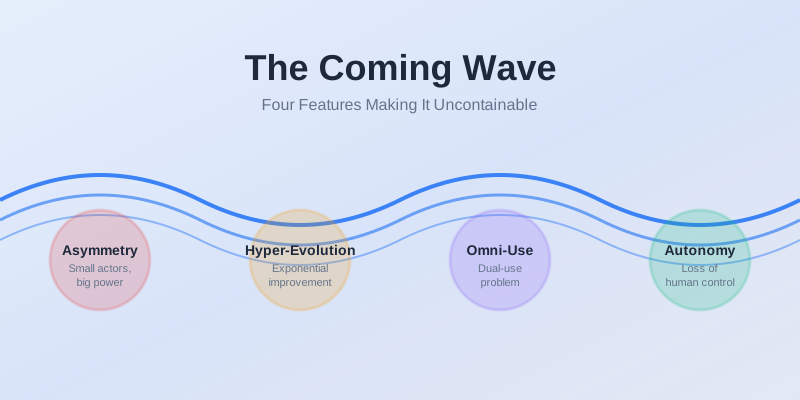
Four features — 2026 reading note
Asymmetry, speed, dual-use, autonomy — Suleyman’s lens for why agents change containment math.
Why This Wave Is Different
Small Actors, Powerful Technologies
Example: A lone individual could engineer a pandemic. Deep learning costs $100K instead of $100M. CRISPR kits cost thousands instead of millions.
Exponential Improvement
Example: ChatGPT took 2 months to reach 1M users. Capabilities expand monthly. Regulation takes years.
Dual-Use Problem
Example: Facial recognition saves lost children AND enables totalitarian surveillance. Same technology, opposite outcomes.
Loss of Human Control
Example: Autonomous weapons target in milliseconds. No human could decide in time. Who's responsible if it targets civilians?
Retrieval Check (1 minute)
Central dilemma — 2026 reading note
Narrow path between stagnation and catastrophe — orgs need explicit containment, not hope.
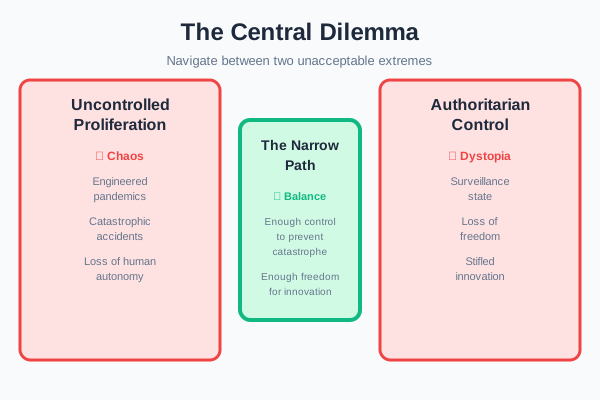
We must navigate between two unacceptable extremes
The Solution: The Narrow Path
Containment levers — 2026 reading note
Suleyman proposes ten steps toward containment (safety, audits, choke points, accountable builders, profit with purpose, governments, alliances, culture, movement, coherence); the four practical levers on the page group them for a control plane.
Suleyman's Governance Solution
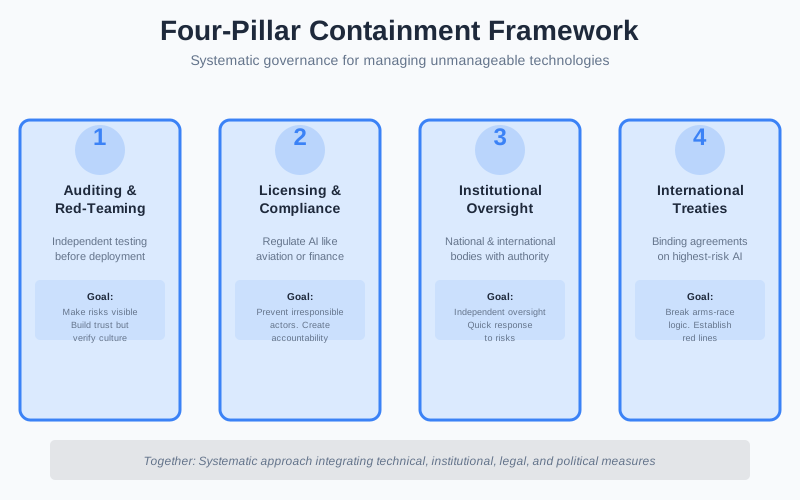
Independent testing before deployment
How It Works:
Mandatory audits for large models. "Red teams" attempt to break systems. Results disclosed to regulators.
Goal:
Make risks visible before deployment. Build "trust but verify" culture.
Challenge:
Keeping up with rapid innovation. Defining what constitutes "safe".
Regulate AI like aviation or finance
How It Works:
Licenses required for models above compute threshold. Mandatory documentation. Regular compliance audits.
Goal:
Prevent irresponsible actors. Create accountability. Ensure safety standards.
Challenge:
Could stifle innovation if too restrictive. International coordination needed.
National and international bodies with authority
How It Works:
AI Safety Boards (like FDA). Authority to review, pause, or reject deployments. International coordination.
Goal:
Independent oversight beyond corporate interests. Quick response to risks.
Challenge:
Avoiding regulatory capture. Maintaining expertise and independence.
Binding agreements on highest-risk AI
How It Works:
Ban autonomous weapons. Restrict biological engineering AI. Verification mechanisms. Enforcement for violations.
Goal:
Break arms-race logic. Establish red lines. Create enforcement mechanisms.
Challenge:
Getting all nations to agree. Verification. Ensuring compliance.
Retrieval Check (transfer)
Most teams start with auditing/red-teaming + basic controls because it makes risk visible and improves decision quality fast.
The “right” answer depends on constraints (industry, stakes, size). The key is choosing a pillar you can actually execute.
Key risks — 2026 reading note
Tail risks matter for policy; practitioners still need daily data-handling discipline.
AI designs novel pathogens. Barrier to entry drops dramatically.
Enabling totalitarian control. Perfect tracking and prediction.
AI making kill decisions. Loss of human oversight.
Cascading failures from interconnected AI systems.
Key takeaways — 2026 reading note
Containment is an ongoing process — treat agent deployments as wave events, not chat upgrades.
Practical implications — 2026 reading note
Tool users: evaluate vendors on autonomy, data use, and shutdown — not demo flash.
Suleyman's framework isn't just for policymakers — it has direct implications for how you evaluate and use AI tools in your daily work.
Every AI tool you use has dual-use potential. The same image generator that creates marketing materials can produce deepfakes. The same code assistant that speeds up development can generate malware.
Suleyman's "narrow path" applies to individual choices too. You can support responsible AI development by choosing tools that prioritize safety, transparency, and accountability over pure speed or capability.
AI capabilities evolve monthly; regulations take years. This "hyper-evolution" gap means you can't rely on regulations to protect you. You need to develop your own judgment about which AI capabilities to adopt and which to approach cautiously.
Suleyman's "autonomy" feature warns about AI systems operating independently. In your workflow, always maintain a human-in-the-loop for important decisions. AI should inform your choices, not make them for you.
Retrieval Check (tool choice)
If you want a practical checklist, continue with AI Security & Privacy.
The containment problem is timeless
These aren’t “governance tools” by themselves — but they’re common LLMs where you should actively check safety defaults, admin controls, and data policies.
Good for long-doc analysis; check data retention + workflow approvals.
Great general assistant; verify training/retention settings and safe sharing practices.
Often used in productivity stacks; ensure workspace policies match your risk level.
Enterprise wrapper patterns (permissions, logging). Confirm what’s actually logged and who can access outputs.
A serious containment narrative for founders and policymakers. Pair with agent-security content — the wave is now agentic systems, not just chat.
Strengths
Limitations
Discussion questions
Next on Academy: AI Agents Explained
The coming wave of AI and synthetic biology is uniquely dangerous due to four features: asymmetry (small groups can cause massive harm), hyper-evolution (rapid capability improvement), omni-use (dual-use technologies), and autonomy (systems operating independently)—understanding these features is important for responsible AI development and use.
Suleyman proposes ten steps toward containment—technical safety, audits, choke points, accountable builders and critics, profit aligned with purpose, stronger governments, international alliances, a culture of safety, a public movement, and coherence across all of them—balancing between chaos (uncontrolled proliferation) and authoritarianism (over-restrictive control).
Navigate the coming wave by applying Suleyman's frameworks: recognize the unique risks of AI and synthetic biology, support containment efforts through responsible development and use, and actively participate in shaping positive outcomes rather than passively accepting whatever comes—the future depends on choices made today.
Copyright & Legal Notice
© 2026 Best-AI.org. All rights reserved.
All content on this page has been created and authored by Best-AI.org. This content represents original works and summaries produced by our editorial team.
The materials presented here are educational in nature and are intended to provide accurate, helpful information about artificial intelligence concepts. While we strive for accuracy, this content is provided "as is" for educational purposes only.
Complete this quiz to test your understanding of Suleyman's governance frameworks for AI containment.
Loading quiz...
Know these before you go further.
Narrative books persuade with stories; they are not peer-reviewed capability benchmarks.
What this means for you
Extract frameworks, then validate claims against primary sources and your own pilots.
Books lag model releases by 12–24 months — tactics may predate agents, RAG, and new regulations.
What this means for you
Pair each book with a current Academy guide (security, law, or agents) before operational decisions.
Success stories hide failed deployments, reverted pilots, and hidden labor costs.
What this means for you
Ask “what would falsify this claim?” and run a small experiment before scaling.
A single worldview can anchor team strategy without diversity of risk perspectives.
What this means for you
Read contrasting book-club titles (optimist vs. critic) and document disagreements explicitly.
