Master Practical AI Collaboration
Based on the NYT Bestseller by Ethan Mollick • Wharton Professor • 2024
TL;DR:
Co-intelligence means humans and AI working together: follow the four rules (always involve humans, be the human in the loop, treat AI like a person, assume this is the worst AI you'll use), map the jagged frontier, and choose centaur or cyborg collaboration models.

AI is Alien: Not human-like, not mechanical—genuinely different cognition.
The Jagged Frontier: Capabilities are unevenly distributed and counterintuitive.
Human in the Loop: Active oversight prevents "falling asleep at the wheel."
Future-Proof: Assume AI will improve dramatically—build flexible workflows.
Alien intelligence — 2026 reading note
Mollick’s frame still holds: LLMs are useful aliens — fluent, non-human, uneven. Don’t anthropomorphize competence.
AI is neither human-like nor purely mechanical—it's genuinely alien. Understanding this alienness is key to effective collaboration.
Ethan Mollick
Four rules — 2026 reading note
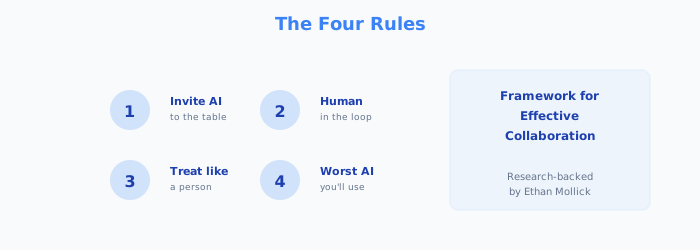
Rules for managers and ICs: invite AI to everything, be the human in the loop, treat it as a person (carefully), and assume rapid change.
Ethan Mollick's practical framework for effective human-AI collaboration, distilled from research and real-world experience.
Always Invite AI to the Table
The only way to learn is through engagement. Skepticism without experimentation prevents adaptation.
Application: Pilot AI tools, document successes and failures, iterate based on results.
Be the Human in the Loop
AI confidently provides incorrect information. Humans must maintain active oversight and verification.
Application: Design workflows ensuring humans make key decisions, verify outputs, and provide feedback.
Treat AI Like a Person (With Caveats)
Give AI roles and context. Humans are good at directing people—use this natural ability.
Application: Specify AI's role ("You are an expert...") and provide context for better results.
Assume This Is the Worst AI You'll Use
AI capabilities expand rapidly. Build processes assuming significant future improvements.
Application: Create flexible workflows that adapt as AI capabilities evolve.
Retrieval Check (30 seconds)
Jagged frontier — 2026 reading note
Superhuman on some tasks, worse than you on neighbors — the BCG pattern still shows up with GPT-class tools.
AI capabilities are unevenly distributed—some tasks are easily within AI's reach, while similar-seeming tasks remain impossible. This creates a "jagged frontier" of unpredictable capabilities.
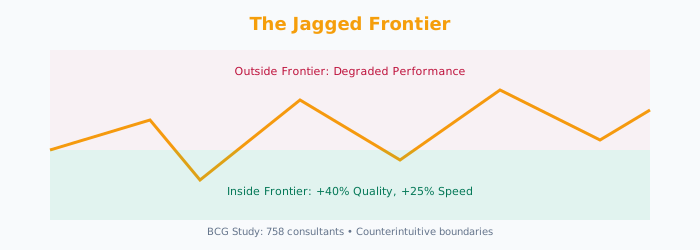
BCG Study: 758 BCG consultants
Retrieval Check (real work)
Answer format: “AI is great at ___, unreliable at ___, and dangerous at ___ for this task.”
Example: Great at drafting 10 variants, unreliable at citing sources, dangerous at sending unreviewed emails.
Centaur vs cyborg — 2026 reading note
Centaur: human and AI divide labor. Cyborg: interleaved collaboration. Pick deliberately per task.
Two distinct collaboration modes, each suited to different contexts and risk profiles.
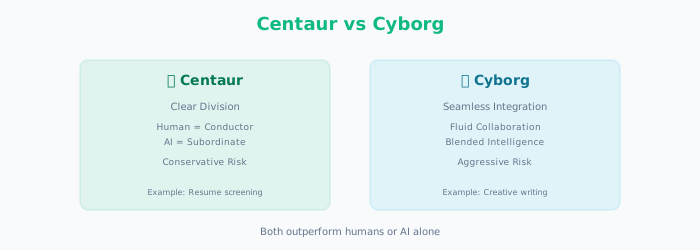
Clear division of labor with humans as conductor
Example: Recruiter uses AI to screen resumes, but humans make final hiring decisions based on cultural fit.
Seamless integration with tasks passed back and forth
Example: Writer and AI collaborate iteratively—drafting, suggesting improvements, revising in continuous loop.
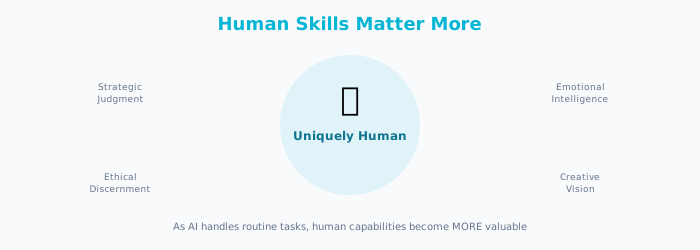
Human skills — 2026 reading note
Judgment, taste, relationships, and accountability rise in value as drafting gets cheaper.
As AI handles routine cognitive tasks, uniquely human capabilities become more valuable, not less.
Future scenarios — 2026 reading note
Assume capability gains; build flexible workflows and policies, not brittle prompt magic.
Rather than predicting, prepare for multiple possible AI futures. Our choices shape which scenario unfolds.
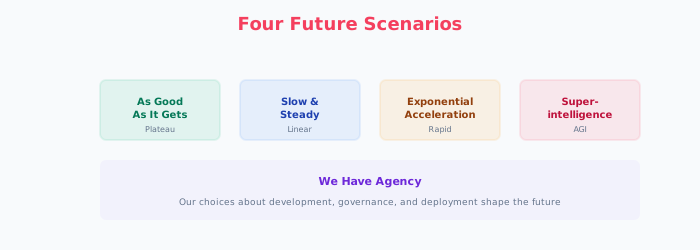
AI plateaus around GPT levels. Continued improvement but no exponential acceleration.
Implication: Proactive adaptation needed, but substantial room for human-driven innovation remains.
Linear advancement with notable breakthroughs every few years.
Implication: Time for institutions and workers to adapt while maintaining human agency.
Each AI generation dramatically surpasses the last.
Implication: Rapid institutional change required. High stakes for governance.
AGI matches or exceeds human capabilities across all domains.
Implication: Massive potential and grave risks. Unprecedented challenges.
Collaboration framework — 2026 reading note
Synthesize Mollick into team policy: where AI proposes, where humans decide, and what never auto-ships.
Decision Framework
Retrieval Check (decision)
The collaboration pattern is timeless
Practice the four rules with these AI tools
Mollick's framework is practical and research-backed, but his optimism overlooks some realities. Here's where we think the book gets it wrong:
Mollick's claim: AI will democratize learning through personalized tutoring (the "2 Sigma Problem" solution).
Reality check: Most educational institutions are moving in the opposite direction—blocking AI sites, using detection tools, and treating AI as a threat. Students are developing anti-AI attitudes. One reviewer noted: "My kids want almost nothing to do with AI" because teachers frame it as cheating.
Our stance: The education system's resistance is structural, not just pedagogical. Mollick underestimates how long institutional change takes. We need policy reform first, not just better AI tools.
Mollick's claim: New jobs will emerge as AI automates existing roles.
Reality check: This ignores the speed mismatch. Retraining takes years; AI improves in months. The BCG study showed 25% faster task completion—that's immediate productivity gains that translate to fewer jobs needed.
Our stance: The "new jobs will emerge" argument is historically true but temporally naive. The transition period will be brutal for many workers. We need stronger safety nets NOW, not optimistic predictions.
Mollick's claim: Keeping humans in the loop prevents AI failures.
Reality check: The BCG study showed humans "fall asleep at the wheel" when AI is very good. Accuracy dropped from 84% to 60-70% because consultants trusted AI too much. Human oversight degrades over time.
Our stance: "Human in the loop" is necessary but insufficient. We need active engagement mechanisms—forcing humans to justify AI decisions, not just approve them. Passive monitoring doesn't work.
What Mollick doesn't address: Who benefits from AI productivity gains?
Reality check: The BCG study participants were elite consultants at a top firm. They got 40% better quality and 25% faster completion. But what about workers without access to premium AI tools? What about companies that capture productivity gains as profit instead of raising wages?
Our stance: AI will amplify existing inequalities unless we actively design for equity. Mollick's framework is great for knowledge workers with resources. It says nothing about the majority.
Bottom Line
Still the best practical frame for human–AI collaboration at work: the jagged frontier and centaur/cyborg models map cleanly to how teams actually adopt ChatGPT and agents in 2026.
Strengths
Limitations
Discussion questions
Next on Academy: AI in Practice
Co-intelligence means humans and AI working together effectively: follow Mollick's four rules—always involve humans, be the human in the loop, treat AI like a person, and assume this is the worst AI you'll use—to build productive collaboration.
Understand the jagged frontier where AI excels unpredictably: map which tasks AI handles well versus poorly, choose between centaur (human-AI handoff) or cyborg (deep integration) collaboration models, and adapt your approach based on the specific task and context.
Master AI collaboration by applying these principles systematically: start with clear role definition, establish feedback loops, iterate based on results, and continuously refine your collaboration model—effective co-intelligence transforms AI from a tool into a true partner.
Copyright & Legal Notice
© 2026 Best-AI.org. All rights reserved.
All content on this page, including text, summaries, explanations, and images, has been created and authored by Best-AI.org. This content represents original works and summaries produced by our editorial team.
The materials presented here are educational in nature and are intended to provide accurate, helpful information about artificial intelligence concepts and applications. While we strive for accuracy, this content is provided "as is" for educational purposes only.
Complete this quiz to test your understanding of practical AI collaboration and Mollick's framework.
Loading quiz...
Know these before you go further.
Narrative books persuade with stories; they are not peer-reviewed capability benchmarks.
What this means for you
Extract frameworks, then validate claims against primary sources and your own pilots.
Books lag model releases by 12–24 months — tactics may predate agents, RAG, and new regulations.
What this means for you
Pair each book with a current Academy guide (security, law, or agents) before operational decisions.
Success stories hide failed deployments, reverted pilots, and hidden labor costs.
What this means for you
Ask “what would falsify this claim?” and run a small experiment before scaling.
A single worldview can anchor team strategy without diversity of risk perspectives.
What this means for you
Read contrasting book-club titles (optimist vs. critic) and document disagreements explicitly.
