Reid Hoffman's Optimistic AI Vision
By Reid Hoffman & Greg Beato • NYT Bestseller • January 2025
TL;DR:
Superagency is optimistic AI agency expansion: be a Bloomer (not a Doomer, Gloomer, or Zoomer) by actively shaping positive futures through iterative deployment, permissionless innovation, and networked autonomy—focus on what could go right, not just what could go wrong.
Academy review: October 6, 2026
Model names and capabilities change frequently. We use provider families (GPT, Claude, Gemini) in Academy copy — verify current tiers on provider sites or our LLM Model Family Guide.
For live model picks, cross-check with our AI Agents guide.
October 2026 reread: superagency moved from chat to agent workflows
Hoffman's agency lens still holds, but the implementation examples changed. OpenAI's Assistants API was sunset on August 26, 2026; current agent-style builds should reference Responses API and Conversations API patterns instead.
Primary source: OpenAI migration guide and OpenAI deprecations.
The Bloomer Manifesto
Four perspectives — 2026 reading note
Doomers, gloomers, zoomers, bloomers — use the map to surface hidden assumptions in exec meetings.

AI is existential threat—stop development
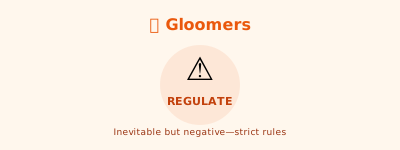
AI inevitable but outcomes negative

Benefits vastly outweigh risks

Balanced optimism with active engagement
Retrieval Check (30 seconds)
Agency expansion — 2026 reading note
AI can expand who gets to do what — if governance keeps humans accountable for externalized harm.
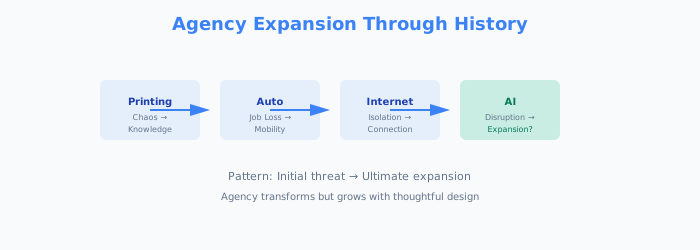
AI debates are fundamentally about human agency—our ability to control lives and influence outcomes.
Historical Pattern
Iterative deployment — 2026 reading note
Ship small, measure, expand — optimism only works with rollback and monitoring.
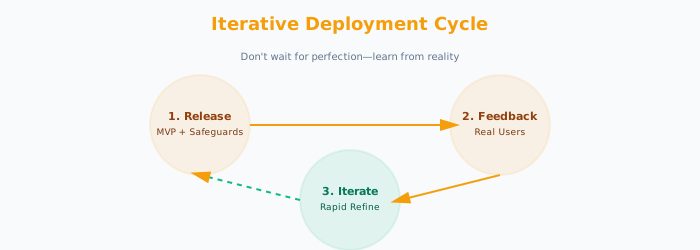
Deploy gradually, gather feedback, iterate rapidly—don't wait for perfection.
Key arguments — 2026 reading note
Extract testable claims from the book; don’t adopt vision slides as engineering specs.
Beyond the four perspectives, Hoffman builds his case on three interconnected principles that distinguish the Bloomer approach from naive optimism.
Hoffman argues that the greatest technological breakthroughs — the internet, smartphones, social media — emerged because innovators didn't need to ask permission first. The same principle applies to AI: lowering barriers to entry enables more people to build, experiment, and solve problems.
Key Insight
Rather than centralized AI controlled by a single entity, Hoffman envisions distributed AI systems where individuals and communities have agency over their own AI tools. This "networked autonomy" creates resilience — no single point of failure, no single point of control.
Perhaps Hoffman's most provocative argument: pausing AI development doesn't make the world safer. If responsible actors stop while adversaries continue, the pause only benefits those unconcerned with safety. The safest path is responsible innovation — building safety into systems through real-world deployment and iteration.
Counterargument to Consider
Retrieval Check (transfer)
Hoffman's framework isn't just theory — it has practical implications for how you choose and use AI tools every day.
Prefer tools that augment your capabilities rather than replace your judgment. Look for AI that makes you more effective, not AI that makes decisions for you.
Don't wait for the "perfect" AI tool. Start with a low-risk workflow, learn from real usage, document the guardrails, and adapt. Iterative deployment applies to personal AI adoption too.
Be a Bloomer in practice: provide feedback to AI companies, participate in AI policy discussions, and share your experiences with others. Your engagement shapes AI's future.
Our perspective — 2026 reading note
Best-AI take: useful for alignment conversations — balance with Law, Security, and Readiness tracks.
We read Hoffman's thesis through the lens of running a platform that tracks thousands of AI tools and educates tens of thousands of learners. Here is where we agree, where we are skeptical, and where we actively disagree.
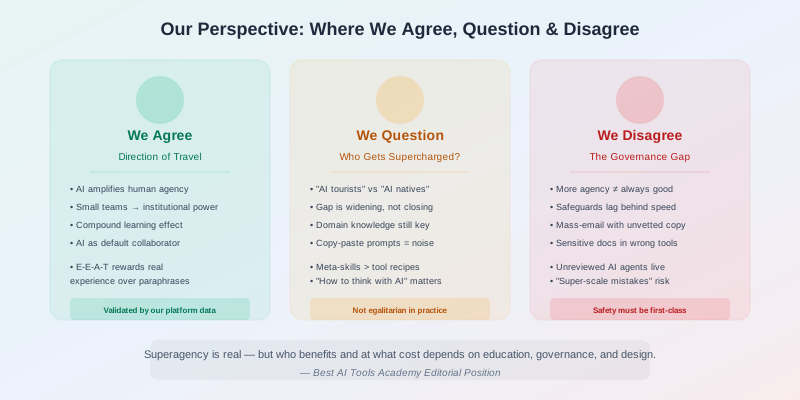
Hoffman's core claim is simple but bold: generative AI does not just automate tasks — it amplifies human agency to a degree that makes individuals and small teams behave like institutions. In 2026, this is no longer speculative. We see it in our own data: solo founders shipping multi-product roadmaps, tiny marketing teams running always-on multichannel campaigns, and individual analysts producing board-level decision material with almost no support.
The meaningful question is no longer "Will AI matter?" but "Who learns to design workflows where AI is the default collaborator?" Teams that treat AI as a core layer already ship faster, test more hypotheses, and learn more per week. This compound learning effect is exactly what Google's E-E-A-T thinking rewards: real experience over syntactic paraphrases.
Hoffman's narrative sounds egalitarian: everyone with access becomes a superagent. In practice, the gap between "AI tourists" and "AI natives" is widening. The people who benefit most already have clear goals, domain knowledge, and a habit of structured experimentation. They know which questions to ask, which outputs to ignore, and when to stop automating and start exercising judgment.
Teaching "how to think with AI" (meta-skills, evaluation, risk awareness) matters more than any specific tool or prompt recipe. See our Prompt Engineering and AI Critical Thinking courses.
We partially disagree with the implicit optimism that "more agency is always good." Our platform data shows a second-order effect: when individuals move extremely fast, organizational safeguards lag behind. It becomes trivial for one well-meaning employee to mass-email thousands of prospects with unvetted AI copy, upload sensitive docs into the wrong tool, or spin up external-facing AI agents that no one in security has reviewed.
Key Concern
One year later — 2026 reading note
Re-read in 2026 through agents and EU AI Act — what held up?
This section is editorial: we revisit Hoffman's core themes and compare them with what practitioners are broadly reporting across products, teams, and workflows through 2026. Treat the labels below as a reading guide, not a scientific scorecard.
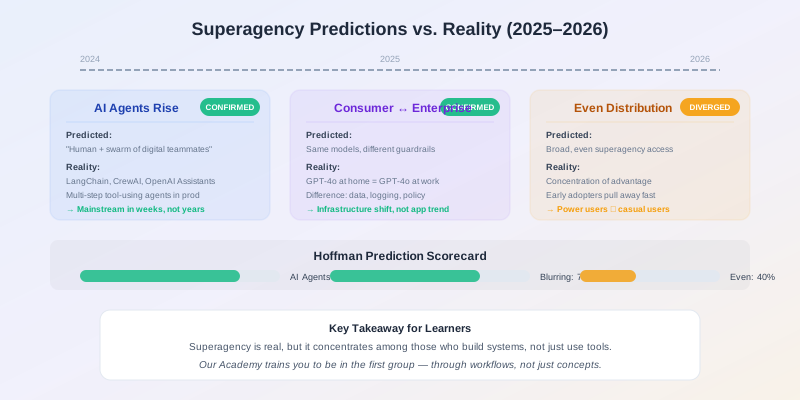
The clearest confirmation: instead of single prompts in a chat box, people now configure multi-step, tool-using AI agents that search, plan, call APIs, and write outputs while the human stays in a supervisory role. LangChain-based agents, OpenAI's Responses API plus Conversations API, and multi-agent orchestration frameworks (CrewAI, LangGraph) have turned a niche research idea into a practical pattern that product teams ship in weeks.
This is exactly the "human plus a swarm of digital teammates" dynamic that superagency predicts. For a hands-on introduction, see our AI Agents Explained course.
Hoffman argued the same underlying models would power personal and work tools, differing only in data and guardrails. In 2026, knowledge workers use the same base models at home and in the office — but wrapped in very different governance shells. At home, they experiment freely; at work, the same capabilities run through internal copilots connected to company data, logging, and policy.
This supports Hoffman's claim that generative AI is an infrastructure shift, not a productivity app trend. Explore how different tools handle this in our AI Tools for Developers and AI Tools for Business directories.
Where reality diverged: the thesis assumes a broad, even distribution of superagency as models get cheaper. What we actually see is concentration of advantage. Organizations that invested early in AI literacy, internal tooling, and data pipelines now pull away from the pack, while late adopters struggle just to write "AI strategy" PDFs.
Individual power users are dramatically more effective than casual users because they build personal toolchains, not just one-off interactions. For our Academy, this leads to a clear design principle: we don't just describe superagency — we train learners to become the kind of operators who can wield it responsibly.
Academy Design Principle
Retrieval Check (2026 reality)
The framework is timeless; the examples are not
Shape positive AI futures
Useful optimism for leaders planning AI adoption — treat it as a vision piece, not an implementation manual. Balance with security and governance tracks.
Strengths
Limitations
Discussion questions
Next on Academy: AI Readiness Framework
Superagency is optimistic AI agency expansion: be a Bloomer (not a Doomer, Gloomer, or Zoomer) by actively shaping positive futures through iterative deployment, permissionless innovation, and networked autonomy—focus on what could go right, not just what could go wrong.
Hoffman's framework categorizes AI perspectives: Doomers fear existential risk, Gloomers worry about near-term harms, Zoomers focus on acceleration, and Bloomers actively build positive outcomes—choosing the Bloomer mindset enables constructive engagement with AI's potential.
Shape positive AI futures by embracing iterative deployment with safeguards, supporting permissionless innovation where risks are understood, and building networked autonomy with accountable ownership—active participation creates better outcomes when paired with evidence, evaluation, and rollback paths.
Copyright & Legal Notice
© 2026 Best-AI.org. All rights reserved.
All content on this page, including text, summaries, explanations, and images, has been created and authored by Best-AI.org. This content represents original works and summaries produced by our editorial team.
The materials presented here are educational in nature and are intended to provide accurate, helpful information about artificial intelligence concepts and applications. While we strive for accuracy, this content is provided "as is" for educational purposes only.
Complete this quiz to test your understanding of Hoffman's optimistic AI vision and agency expansion.
Loading quiz...
Know these before you go further.
Narrative books persuade with stories; they are not peer-reviewed capability benchmarks.
What this means for you
Extract frameworks, then validate claims against primary sources and your own pilots.
Books lag model releases by 12–24 months — tactics may predate agents, RAG, and new regulations.
What this means for you
Pair each book with a current Academy guide (security, law, or agents) before operational decisions.
Success stories hide failed deployments, reverted pilots, and hidden labor costs.
What this means for you
Ask “what would falsify this claim?” and run a small experiment before scaling.
A single worldview can anchor team strategy without diversity of risk perspectives.
What this means for you
Read contrasting book-club titles (optimist vs. critic) and document disagreements explicitly.
