How to Think About AI
Master Richard Susskind's Critical Frameworks
By Richard Susskind • Published 2024 • Critical Thinking Foundation
TL;DR:
Think critically about AI using Susskind's frameworks: shift from "is AI intelligent?" to "what can AI do?", balance process vs. outcome thinking, evaluate across seven risk categories, and plan for multiple futures—move from hype to structured analysis.

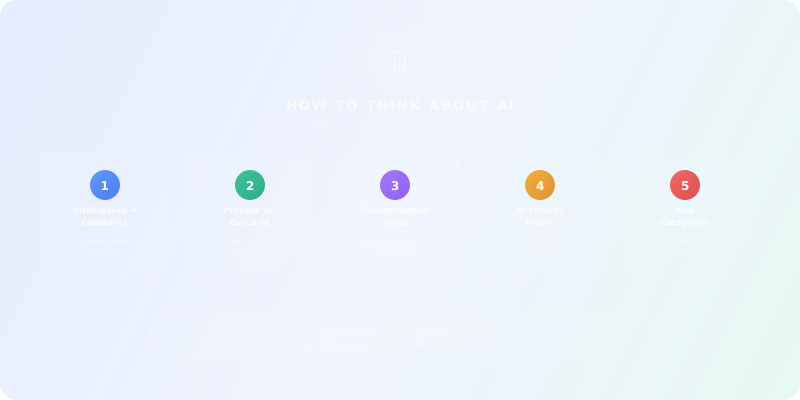
Critical Thinking Foundation
Intelligence vs capability — July 2026 reading note
Separate “acts intelligent” from “is reliable” — capability maps are task-specific.
- Define capability as behavior on your data.
- Avoid debating consciousness in procurement.
- Use tool evaluation section below.
Intelligence-to-Capability Shift
Judge AI by what it does (capability), not whether it "thinks" like humans (intelligence).
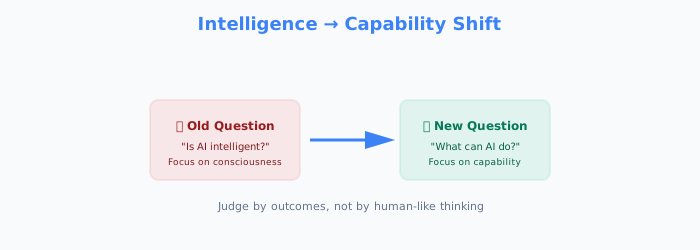
Key Insight
❌ Traditional Focus:
Focus on consciousness, understanding, human-like reasoning
✅ New Thinking:
Focus on outcomes, performance, practical utility
Application
Process vs outcome — July 2026 reading note
Good outcomes with bad process don’t scale; bad outcomes with good process teach faster.
- Document process for one AI workflow.
- Review outcomes weekly, not once.
- Pair with In Practice patterns.
Process vs. Outcome Thinking
The most powerful framework: Distinguish between trusting the process vs. trusting the outcome.

🔄 Process-Thinking:
- • Trust doctors because they went to medical school
- • Trust judges because they follow proper procedures
- • Worried AI won't replace them because "process is wrong"
🎯 Outcome-Thinking:
- • Want the diagnosis that's correct
- • Want legal research that finds relevant cases
- • AI can deliver outcomes even without human-like process
Application
Automation vs innovation — July 2026 reading note
Automation cuts cost; innovation changes what you offer — AI projects confuse the two constantly.
- Label current projects automate vs innovate.
- Allocate budget separately.
- Kill zombie automations with no ROI.
Automation, Innovation, Elimination
Three ways AI transforms work—each requires different strategy.
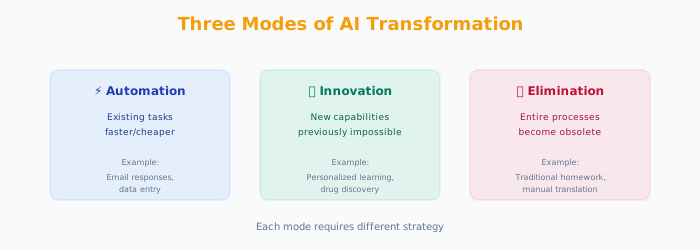
Automation
AI does existing tasks faster/cheaper
Example: Automated email responses, data entry
Innovation
AI enables new capabilities previously impossible
Example: Personalized learning at scale, drug discovery
Elimination
AI makes entire processes obsolete
Example: Traditional homework, manual translation
Application
AI futures — July 2026 reading note
Scenario thinking without commitment — use futures to stress policies, not to pick vendors.
- Run a 90-minute scenario workshop.
- Extract one policy change per scenario.
- Don’t confuse fiction with roadmap dates.
Five AI Futures Matrix
Five possible scenarios for AI development—plan for multiple futures, not just one.
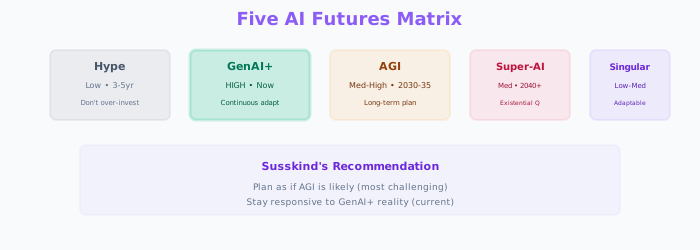
| Future | Likelihood | Timeline | Strategy |
|---|---|---|---|
| Hype | Low | 3-5 years | Don't over-invest; question assumptions |
| GenAI+ | HIGH | Ongoing | Continuous adaptation; invest strategically |
| AGI | Medium-High | 2030-35 | Plan long-term; develop resilience |
| Superintelligence | Medium | 2040+ | Existential questions matter |
| Singularity | Low-Medium | ??? | Emphasize adaptability |
Susskind's Recommendation
Risk categories — July 2026 reading note
Bucket risks: safety, bias, labor, security, misuse — different owners, different mitigations.
- Assign an owner per risk category.
- Link to Security and Law guides.
- Review quarterly as models change.
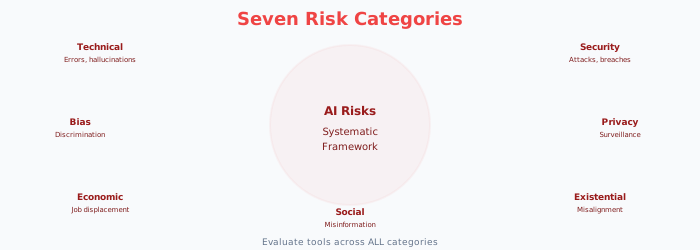
Seven Risk Categories
Systematic framework for AI risks—move from vague anxiety to structured thinking.
Application
Tool evaluation — July 2026 reading note
Philosophy meets procurement: define values and metrics before you trial tools.
- Use the on-page evaluation checklist.
- Run parallel trials on two families.
- Record decision rationale for auditors.
AI Tool Evaluation Framework
Apply Susskind's frameworks when evaluating any AI tool:
✅ Questions to Ask:
- Capability: What can this tool actually do?
- Outcome: Does it solve my problem effectively?
- Process: Can I understand how it works?
- Type: Is this automation, innovation, or elimination?
- Risks: Which of the 7 categories apply?
- Future: How does this fit multiple AI scenarios?
❌ Avoid These Traps:
- ❌ Asking "Is it intelligent?" instead of "What can it do?"
- ❌ Only process-thinking OR only outcome-thinking
- ❌ Treating all AI as just "automation"
- ❌ Vague anxiety instead of structured risk analysis
- ❌ Predicting one future instead of planning for multiple
- ❌ Evaluating based on hype instead of frameworks
Platform Integration
Frequently Asked Questions
What is the intelligence-to-capability shift?▾
Why is process vs. outcome thinking so important?▾
How do I identify automation vs. innovation vs. elimination?▾
Which AI future should I plan for?▾
How do I systematically evaluate AI risks?▾
Apply It: Evaluate an AI Tool with Susskind's Frameworks
- 1Choose an AI tool you use or are considering. Browse AI Tools
- 2Capability Shift: What can this tool actually DO? List 3 concrete capabilities — not marketing claims.
- 3Process vs. Outcome: Can you understand HOW it reaches its outputs? Or do you only see the result?
- 4Three-Way Classification: Is this tool automating a task, innovating a new approach, or eliminating a role entirely?
- 5Risk Assessment: Apply at least 3 of Susskind's 7 risk categories to this tool (bias, privacy, accountability, etc.).
The questions are timeless; the answers are not
Apply Susskind's Frameworks
Editorial assessment: How to Think About AI
Strong complement to our Critical Thinking course — best for readers who want philosophical and policy lenses, not tool tutorials.
Strengths
- Multiple perspectives on risk and opportunity
- Good book-club discussion fuel
Limitations
- Not a hands-on manual
- Overlap with other critical-thinking content on the site
Discussion questions
- Which framework in the book changed your mind the most?
- Where do ethics and business incentives conflict in your industry?
- What would you measure to know AI is helping, not just speeding up?
Next on Academy: AI Critical Thinking
Key Insights: What You've Learned
Think critically about AI using Susskind's frameworks: shift from "is AI intelligent?" to "what can AI do?", balance process vs. outcome thinking, evaluate across seven risk categories, and plan for multiple futures—move from hype to structured analysis.
Apply systematic evaluation by considering capability (what AI can do), risk (what could go wrong), governance (how to manage it), and futures (multiple possible outcomes)—structured thinking prevents both over-optimism and excessive fear.
Master AI evaluation by using these frameworks consistently: assess capabilities realistically, identify risks systematically, design governance thoughtfully, and plan for uncertainty—critical thinking about AI enables better decisions, better tools, and better outcomes.
Copyright & Legal Notice
© 2026 Best-AI.org. All rights reserved.
All content on this page, including text, summaries, explanations, and images, has been created and authored by Best-AI.org. This content represents original works and summaries produced by our editorial team.
The materials presented here are educational in nature and are intended to provide accurate, helpful information about artificial intelligence concepts and applications. While we strive for accuracy, this content is provided "as is" for educational purposes only.
Test Your Knowledge
Complete this quiz to test your understanding of Susskind's critical AI frameworks.
Loading quiz...
Risks & Responsible Use
Know these before you go further.
Anecdote ≠ Evidence
Narrative books persuade with stories; they are not peer-reviewed capability benchmarks.
What this means for you
Extract frameworks, then validate claims against primary sources and your own pilots.
Publication Lag
Books lag model releases by 12–24 months — tactics may predate agents, RAG, and new regulations.
What this means for you
Pair each book with a current Academy guide (security, law, or agents) before operational decisions.
Selection Bias in Case Studies
Success stories hide failed deployments, reverted pilots, and hidden labor costs.
What this means for you
Ask “what would falsify this claim?” and run a small experiment before scaling.
Over-Indexing on One Author
A single worldview can anchor team strategy without diversity of risk perspectives.
What this means for you
Read contrasting book-club titles (optimist vs. critic) and document disagreements explicitly.