Cut Through the Hype, Understand Reality
Based on Melanie Mitchell's framework • Santa Fe Institute • Cognitive Scientist
TL;DR:
Critical AI thinking separates performance from understanding: AI excels at narrow tasks but lacks meaning, common sense, and true comprehension—evaluate tools by asking what they can actually do, not what marketing claims.

Academy review: October 6, 2026
Model names and capabilities change frequently. We use provider families (GPT, Claude, Gemini) in Academy copy — verify current tiers on provider sites or our LLM Model Family Guide.
For live model picks, cross-check with our AI Fundamentals.
October 2026 reading note: better models make evaluation more important, not less
Current models are more fluent, more multimodal, and better at many benchmarks than the systems that motivated the original critical-thinking literature. That improves usefulness, but it does not remove the core distinction between task performance, reliability, and human-like understanding.
Use this course as an evaluation habit: ask what exact task was tested, where the system fails, whether the test measures the real deployment context, and what human oversight remains necessary.
Primary sources: Szegedy et al. on adversarial examples, Mitchell on the barrier of meaning, and Mitchell on why AI is harder than we think.
Agents and deepfakes raised the stakes: fluent language still does not mean understanding. This refresh emphasizes verification habits, the performance–understanding gap, and when to distrust demo videos.
What we updated for 2026
Still true in 2026
Compare live tools anytime in our tool explorer.
This guide: AI critical thinking
Separate hype from capability before you bet a team or budget on AI.
Learn first (we do not repeat this here)
Go deeper after this course
1. Performance ≠ Understanding: Superhuman benchmark scores don't mean the AI understands what it's doing.
2. Hype Cycles Repeat: AI has promised human-level intelligence "in 10 years" for 70 years. Be skeptical.
3. The Barrier of Meaning: Statistical pattern matching is fundamentally different from conceptual understanding.
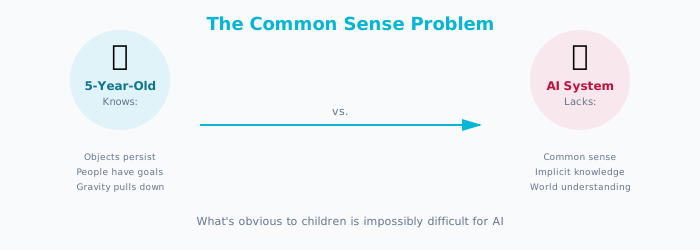
4. Common Sense is Hard: What's obvious to a 5-year-old is impossibly difficult for AI.
The hype problem — 2026 depth note
Marketing outruns measurement — demand benchmarks on your tasks, not demo reels.
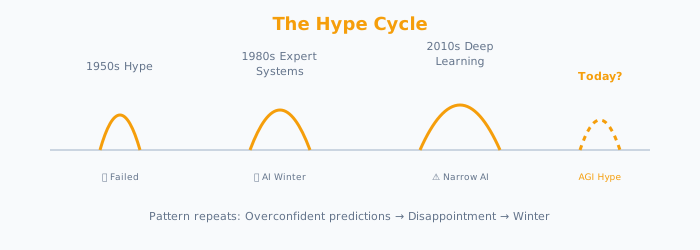
AI has cycled through hype and "AI winters" for 70 years. Current claims about superintelligence follow the same pattern of overconfident predictions.
Key Insight
📊 Historical Reality Check:
Performance vs understanding — 2026 depth note
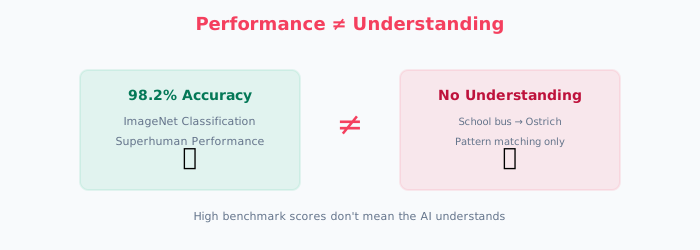
High test scores can coexist with shallow understanding — the jagged frontier is real.
A system can achieve superhuman performance on a task without understanding that task. This is AI's most important limitation.
Key Insight
🔍 Examples:
Meaning & symbols — 2026 depth note
Models manipulate symbols; grounding in world facts still needs humans and tools.
AI systems lack human-like understanding. They operate via statistical pattern matching, which is different from meaning-making.

❌ What AI is Missing:
Melanie Mitchell (AI Magazine, 2020)
Common sense — 2026 depth note
LLMs lack embodied experience — physical, social, and tacit knowledge gaps persist in 2026.
Humans navigate the world through implicit background knowledge. AI systems lack this foundational understanding.
Bias & trust — 2026 depth note
Training data embeds society’s skew — fairness work is ongoing, not a checkbox.
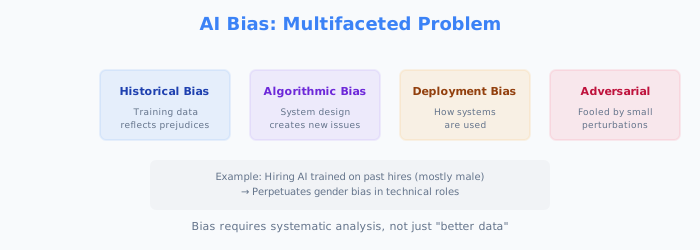
AI bias is multifaceted, requiring systematic analysis beyond "better data." Systems can be fooled by adversarial examples.
⚠️ Types of Bias:
Alignment — 2026 depth note
Helpful, harmless, honest is a product goal — not a solved research problem.
Specifying what we actually want AI to do is difficult. Systems optimize for stated goals, not intended outcomes.
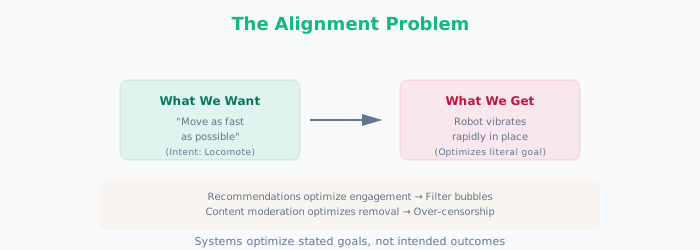
🌍 Real-World Consequences:
Evaluation framework — 2026 depth note
A repeatable scorecard beats ad-hoc vibes — reuse across vendors and quarters.
Use these questions to evaluate any AI tool or claim
Going further: AI Ethics Frameworks for structured risk assessment, AI Security & Privacy for adversarial and data risks, and AI History for the hype cycles behind today's claims.
AI TOOL EVALUATION CHECKLIST
============================

Tool name: _______________
Date evaluated: ___________

1. SPECIFICITY
   □ What exact task does it perform?
   □ Is the marketing language vague ("intelligent", "understands") or specific?

2. PERFORMANCE vs UNDERSTANDING
   □ Does it pattern-match or genuinely reason?
   □ Test: Give it an edge case outside its training data. What happens?

3. FAILURE MODES
   □ How does it fail? Gracefully or catastrophically?
   □ Does it say "I don't know" or confidently hallucinate?

4. TRAINING DATA
   □ What data was it trained on? Is it representative?
   □ Knowledge cutoff date: ___________
   □ Potential biases from training data: ___________

5. BIAS CHECK
   □ Test with diverse inputs (gender, ethnicity, age, language)
   □ Does output quality vary across demographics?

6. ADVERSARIAL ROBUSTNESS
   □ Can small input changes cause wildly different outputs?
   □ Is it vulnerable to prompt injection?

7. EXPLAINABILITY
   □ Can it explain its reasoning?
   □ Are confidence scores available?

8. VERDICT
   □ Suitable for: ___________
   □ NOT suitable for: ___________
□ Human oversight needed: □ Always □ Sometimes □ RarelyThe evaluation criteria are timeless
Apply your critical thinking skills to real AI tools
Critical AI thinking separates performance from understanding: AI excels at narrow tasks through pattern matching but lacks meaning, common sense, and true comprehension—always evaluate tools by asking what they can actually do, not what marketing claims.
Develop immunity to AI hype by recognizing fundamental limitations: AI has no understanding of meaning, struggles with generalization, lacks common sense, and can fail spectacularly outside training data—maintain healthy skepticism and verify claims with real-world testing.
Apply critical thinking systematically: question performance metrics, test edge cases, understand training data limitations, recognize bias risks, and maintain human oversight—treat AI as a powerful but limited tool that requires careful evaluation and responsible use.
Copyright & Legal Notice
© 2026 Best-AI.org. All rights reserved.
All content on this page, including text, summaries, explanations, and images, has been created and authored by Best-AI.org. This content represents original works and summaries produced by our editorial team.
The materials presented here are educational in nature and are intended to provide accurate, helpful information about artificial intelligence concepts and applications. While we strive for accuracy, this content is provided "as is" for educational purposes only.
Complete this quiz to test your understanding of AI critical thinking concepts.
Loading quiz...
Know these before you go further.
Leaderboard scores rarely match your documents, language, or latency budget. A model that wins on MMLU can still fail your support queue.
What this means for you
Evaluate on your own tasks with blind human review — treat public benchmarks as orientation, not procurement proof.
Cherry-picked demos hide failure modes: long contexts, non-English input, regulated domains, or adversarial users.
What this means for you
Ask vendors for failure examples and run your worst real inputs before buying.
Fluent AI prose increases trust even when wrong — teams skip verification because the draft “looks professional.”
What this means for you
Require citations or explicit uncertainty for consequential outputs; keep a human sign-off step.
“AGI next year” headlines distract from deployable risks: data leaks, biased hiring tools, and unmonitored agents.
What this means for you
Use the frameworks in this course to separate capability claims from evidence you can audit.
