Ten Visions for Our Future — A Critical Reading
TL;DR:
AI 2041 is one of the most influential attempts to make AI futures feel normal. It's technically grounded and often directionally accurate — but it quietly assumes that more AI, more data, and more optimization are usually the right answers. Read it as both a guide and a foil, then test each scenario against current evidence.
Authors: Kai-Fu Lee (former president of Google China, CEO of Sinovation Ventures) & Chen Qiufan (award-winning science fiction author) • Published: 2021 • Length: ~480 pages
Central Innovation
Academy review: October 6, 2026
Model names and capabilities change frequently. We use provider families (GPT, Claude, Gemini) in Academy copy — verify current tiers on provider sites or our LLM Model Family Guide.
For live model picks, cross-check with our AGI Timelines guide.
October 2026 read-through: evidence beats vibe-based futurism
Use AI 2041 as a scenario generator, then test each story against live indicators: adoption, benchmark saturation, deployment incidents, labor effects, regulation, and autonomous task horizons.
Reference baselines: Stanford AI Index and METR research.
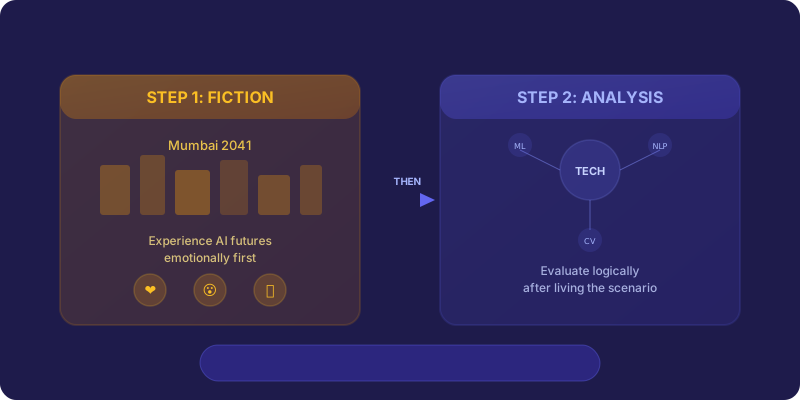
Scientific fiction — 2026 reading note
Stories persuade emotionally — use them in workshops, not as engineering timelines.
Why the Format Matters
You experience AI futures emotionally before you evaluate them logically. By the time you get to the analysis, you've already "lived" the scenario through the characters.
When a scenario is wrapped in a personal story — a kid with a learning tutor, an elderly parent with AI care — it starts to feel less like a choice and more like an inevitable trajectory of "progress".
Most core tensions — labor displacement, data governance, nudging, algorithmic power — appear as things to be tuned and optimized, not contested.
For Your Academy
What aged well — 2026 reading note
Some scenarios landed as prototypes — update with 2026 facts, don’t treat as prophecy.
By 2026, a non-trivial chunk of AI 2041 no longer reads like distant sci-fi. Stanford's AI Index and independent evaluation work show the same pattern from another angle: adoption, investment, benchmark saturation, and autonomous-agent capability are moving faster than institutions can absorb.
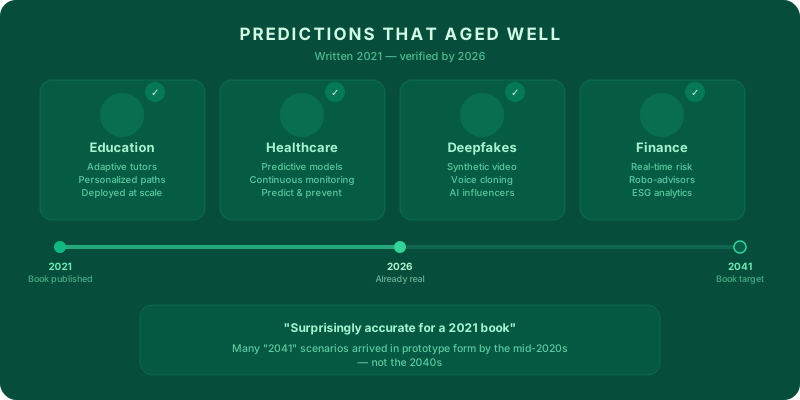
Intelligent tutors, adaptive learning, and personalized study paths are moving fast: they are widely available in consumer tools and increasingly tested via institutional pilots — with uneven quality and important integrity/privacy trade-offs.
Models that anticipate disease risk and monitor patients continuously are moving into mainstream healthcare infrastructure, shifting from "diagnose and treat" toward "predict and prevent".
The explosion of believable synthetic video, voice cloning, and AI-generated influencers arrived earlier than many policymakers were ready for.
"Robo-advisors on steroids", real-time risk modeling, and AI-augmented treasury and ESG analytics are becoming standard in financial infrastructure.
Why This Matters
Blind spot — 2026 reading note
Solutionism and “neutral tech” narratives hide politics and power — still common in AI marketing.
The most important critique — and the one learners almost never see in mainstream summaries — is about the ideology baked into the stories. Virginia L. Conn's review in the Los Angeles Review of Books calls out what she terms the "tyranny of neutrality".
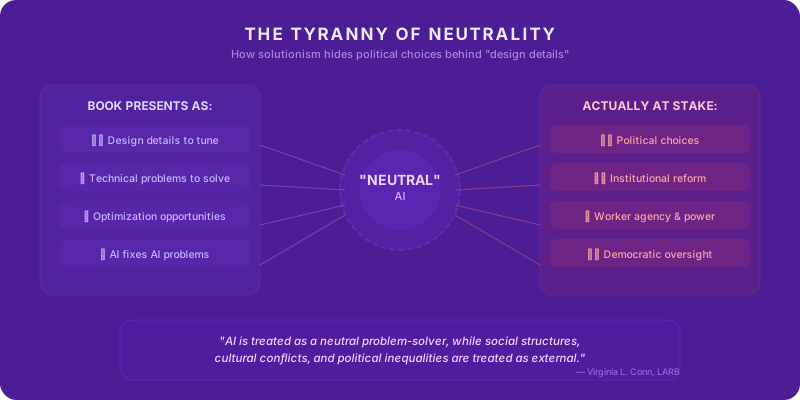
The book repeatedly presents AI as a neutral problem-solver, while social structures, cultural conflicts, and political inequalities are treated as "external" issues that AI simply reacts to or optimizes.
Example — "Twin Sparrows": The solution to a child's autism is not community adaptation, inclusive schools, or changing expectations — it is an AI companion that better understands him, leaving underlying social norms unchanged.
AI 2041 quietly advances a worldview where more data and better algorithms are the default answer to human and societal complexity. That framing:
The Value for Learners
Jobs & inequality — 2026 reading note
Labor impacts need policy and product choices — not just individual upskilling slogans.
Lee's earlier work, AI Superpowers, puts a heavy focus on jobs, inequality, and geopolitical competition. AI 2041 softens that through fiction — but the underlying assumptions are still there.
Distinguishes between jobs AI will take (routine, repetitive, data-driven) and those it won't (creative, strategic, high-touch roles).
Calls for retraining and elevating human-centric work in care, creativity, and complex social contexts.
The stories rarely linger on the messy transition: who funds retraining, what happens in regions without safety nets, how power imbalances between AI-rich platforms and workers get managed.
Lee often defaults to the argument that "AI researchers will solve AI-caused problems" — bias fixed by better models, privacy by better tech, deepfakes by better detection.
Timelines — 2026 reading note
Comforting non-AGI timelines aged badly — plan for rapid capability jumps without panic.
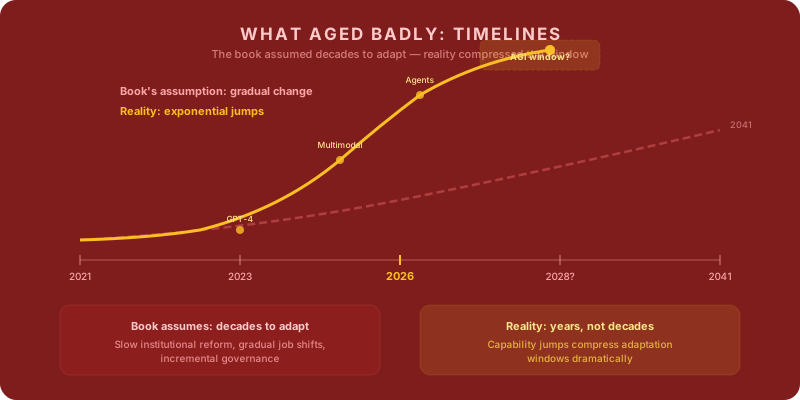
One of the more interesting 2026 critiques is that AI 2041's most dated element may be its comforting distance from AGI. Lee emphasized powerful narrow systems and incremental disruption. That remains a useful corrective to hype, but today's frontier discussion is less settled: capability evaluations, agent task horizons, and AI R&D automation all make the timing question harder to dismiss.
We have decades to slowly adapt
Systems, jobs, and governance will gradually adjust to a more powerful version of 2021-style AI. Institutions have time to catch up.
Years, not decades
Capability jumps (especially in multimodal models and agents) are compressing adaptation windows.
Many "2041" scenarios arrived in early form in the mid-2020s.
Forecasts have compressed, but credible timelines remain contested; treat specific AGI dates as assumptions, not facts.
Implication for Your Learning
Debate partner — 2026 reading note
Best use: structured debate with mixed functions — extract safeguards, not roadmaps.
Instead of listing it as "another future-of-AI book", position AI 2041 as a structured debate partner inside your learning:
Assign one or two stories plus Lee's analysis. Pair them with critical reviews (e.g., LARB's "tyranny of neutrality").
Discussion Prompts:
Map each story's domain (education, insurance, smart cities) to current tools and deployments.
Exercises:
Use AI 2041 to illustrate stages of readiness: from "curious" to "leading". But explicitly add a dimension missing in the book: organizational and societal responsibility — not just technical capability.
See our AI Readiness Framework for a structured assessment.
The skill is timeless, even if the predictions are dated
Apply the book's lens to real AI tools
Sci-fi scenarios as stress tests — great for workshops, not forecasting. Use stories to design red-team exercises for your product.
Strengths
Limitations
Discussion questions
Next on Academy: AI Agents Explained
AI 2041's "scientific fiction" format is a powerful persuasion architecture: stories lower skepticism, naturalize certain outcomes, and frame political choices as design details — understanding this mechanism is the first step to reading AI narratives critically.
The book's near-term predictions are surprisingly useful as scenario prompts, but its timeline assumptions should be treated as conservative — capability jumps are compressing adaptation windows from decades to years, while specific AGI dates remain contested.
The most important lesson is what the book hides: a solutionist worldview where more AI, more data, and more optimization are always the answer — your job is to ask who wins, who loses, and what alternatives are silently taken off the table.
Copyright & Legal Notice
© 2026 Best-AI.org. All rights reserved.
All content on this page has been created and authored by Best-AI.org. This content represents original works and summaries produced by our editorial team.
The materials presented here are educational in nature and are intended to provide accurate, helpful information about artificial intelligence concepts. While we strive for accuracy, this content is provided "as is" for educational purposes only.
Complete this quiz to test your understanding of AI 2041's key arguments, blind spots, and critical reading techniques.
Loading quiz...
Know these before you go further.
Narrative books persuade with stories; they are not peer-reviewed capability benchmarks.
What this means for you
Extract frameworks, then validate claims against primary sources and your own pilots.
Books lag model releases by 12–24 months — tactics may predate agents, RAG, and new regulations.
What this means for you
Pair each book with a current Academy guide (security, law, or agents) before operational decisions.
Success stories hide failed deployments, reverted pilots, and hidden labor costs.
What this means for you
Ask “what would falsify this claim?” and run a small experiment before scaling.
A single worldview can anchor team strategy without diversity of risk perspectives.
What this means for you
Read contrasting book-club titles (optimist vs. critic) and document disagreements explicitly.
