From Symbolic AI to Deep Learning Revolution
TL;DR:
AI's 70-year journey: symbolic AI failed because it couldn't handle real-world complexity, but neural networks succeeded by learning patterns from data—this shift explains why modern AI tools work and where they're heading.

Academy review: October 6, 2026
Model names and capabilities change frequently. We use provider families (GPT, Claude, Gemini) in Academy copy — verify current tiers on provider sites or our LLM Model Family Guide.
For live model picks, cross-check with our AI Fundamentals.
October 2026 reading note: history is the antidote to both hype and dismissal
The newest systems feel unprecedented, but the pattern is familiar: capability jumps, over-broad claims, painful limits, then practical integration. AI history helps you separate a real paradigm shift from a temporary leaderboard moment.
Read the timeline as a set of recurring lessons: brittle rules gave way to learned representations, data and compute changed what scaled, and each breakthrough still created new failure modes rather than ending the need for judgment.
The timeline now includes the shift from chatbots to agentic systems, EU AI Act enforcement, and open-weight models catching up on coding tasks. History explains why today’s tools feel different from 2022’s “one chat window.”
What we updated for 2026
Still true in 2026
Compare live tools anytime in our tool explorer.
This guide: AI history
Milestones and context — how we got to today’s agent-heavy stack.
Go deeper after this course
Classical AI (1956-2000): Rule-based systems failed due to brittleness, manual knowledge encoding, and inability to scale.
Deep Learning (2012+): Neural networks learn features automatically from data, achieving human-level performance in vision, speech, language, and games.
Paradigm Shift: From "programming intelligence" to "learning intelligence from data."
1950s–60s beginnings — 2026 depth note
Early AI promised reasoning; hardware and data limits kept wins narrow — pattern repeats each hype cycle.
The Dartmouth Conference formally established AI as a field, with early successes in logical reasoning and problem-solving. Pioneers believed "every aspect of intelligence can be precisely described so a machine can simulate it."
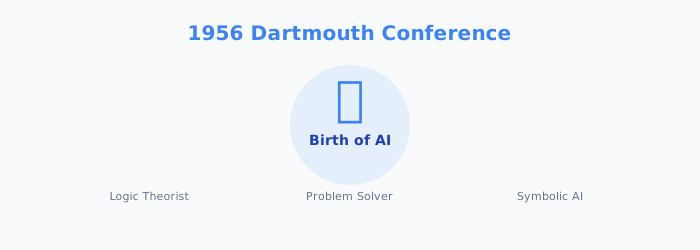
🎯 Key Milestone:
1956 Dartmouth Conference - John McCarthy, Marvin Minsky, Claude Shannon
🔬 Approach:
Symbolic AI - explicit rules and logic
✨ Major Achievements:
Symbolic AI — 2026 depth note
Hand-coded rules work until the world gets messy — still visible in spreadsheets and expert systems.
Focus on expert systems and knowledge representation. AI tried to encode human expertise into explicit rules. Despite initial promise, these systems proved fundamentally limited.

🎯 Key Milestone:
Expert Systems boom - MYCIN, DENDRAL
🔬 Approach:
Rule-based systems, symbolic logic, manual knowledge encoding
✨ Major Achievements:
Limitations
Games & search — 2026 depth note
Chess and Go victories were real but narrow — don’t confuse game mastery with open-world competence.
Game-playing AI evolved from brute-force chess engines to AlphaGo's creative strategies in the vastly complex game of Go.
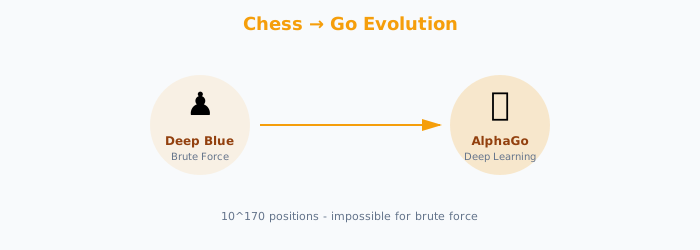
🎯 Key Milestone:
Deep Blue defeats Kasparov (1997), AlphaGo defeats Lee Sedol (2016)
🔬 Approach:
Chess: Brute-force search. Go: Deep neural networks + self-play
✨ Major Achievements:
Why This Matters
Perception revolution — 2026 depth note
Vision and speech crossed usability thresholds with deep nets — multimodal chat builds on this era.
Teaching machines to see and hear. Classical approaches struggled until deep learning achieved human-level performance.
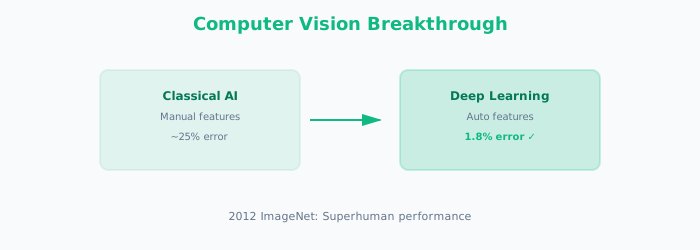
🎯 Key Milestone:
2012 ImageNet breakthrough
🔬 Approach:
Classical: Manual feature engineering. Deep Learning: Automatic feature extraction
✨ Major Achievements:
Breakthrough
Language era — 2026 depth note
Transformers shifted NLP from pipelines to pre-trained models — the direct ancestor of ChatGPT-class tools.
Natural language processing evolved from grammar rules to statistical models to transformer-based LLMs.
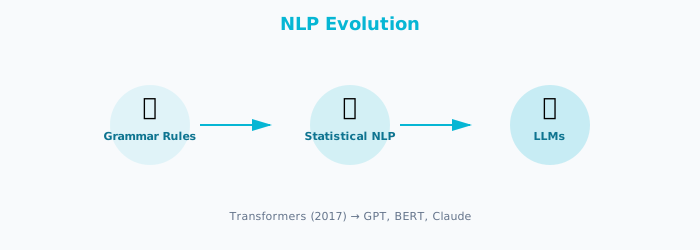
🎯 Key Milestone:
Transformer architecture (2017), GPT/BERT era
🔬 Approach:
Grammar rules → Statistical NLP → Transformers → LLMs
✨ Major Achievements:
Deep learning mainstream — 2026 depth note
2012+ made learning features standard — GPUs, data, and transformers followed.
Deep neural networks fundamentally changed AI, achieving superhuman performance across vision, speech, language, and games. Geoffrey Hinton's decades of neural network research finally proved successful.

🎯 Key Milestone:
2012 ImageNet (AlexNet), 2016 AlphaGo, 2017 Transformers
🔬 Approach:
Multi-layer neural networks trained on massive datasets using GPUs/TPUs
✨ Major Achievements:
Paradigm Shift
Lessons for today — 2026 depth note
Cycles of hype and winter repeat — durable value is workflow fit and governance, not buzzwords.
The Central Insight
History repeats — learn the pattern, not the timeline
AI HISTORY TIMELINE — KEY MILESTONES
=====================================

1950  Turing Test proposed — "Can machines think?"
1956  Dartmouth Conference — AI officially born (McCarthy, Minsky, Shannon)
1966  ELIZA chatbot — first conversational AI (pattern matching)
1970s Expert Systems boom (MYCIN, DENDRAL) — rule-based AI
1980s AI Winter #1 — expert systems proved too brittle
1997  Deep Blue defeats Kasparov at chess (brute-force search)
2006  Hinton and colleagues' deep belief nets — renewed interest in deep neural networks
2012  ImageNet breakthrough — AlexNet wins with a huge margin (deep learning + GPUs go mainstream)
2014  GANs invented (Goodfellow) — AI can generate realistic images
2016  AlphaGo defeats Lee Sedol — deep learning masters Go
2017  "Attention Is All You Need" — Transformer architecture invented
2018  BERT (Google) — bidirectional language understanding
2020  early large-scale GPT (175B parameters) — language generation at scale
2022  ChatGPT launches (Nov 30) — AI goes mainstream
2023  GPT multimodal — text + image understanding
2024  EU AI Act adopted — first major AI regulation
2025+ Open-source models (Llama, Mistral), AI agents, multimodal AI

THE PARADIGM SHIFT:
Classical AI (1956-2000): "Program intelligence with rules" → FAILED
Deep Learning (2012+): "Learn intelligence from data" → SUCCEEDED

Why it matters: Every AI tool you use today is built on deep learning.The journey of artificial intelligence began with grand ambitions at the 1956 Dartmouth Conference, where pioneers like John McCarthy, Marvin Minsky, and Claude Shannon believed that "every aspect of learning or any other feature of intelligence can in principle be so precisely described that a machine can be made to simulate it."
For decades, researchers pursued symbolic AI—encoding human knowledge into explicit rules and logical systems. Expert systems like MYCIN showed promise in narrow domains like medical diagnosis, but these approaches had fundamental limitations. They were brittle, breaking down when encountering unexpected situations. They required painstaking manual knowledge engineering. And they simply couldn't scale to handle the complexity of real-world problems.
The failure of classical AI wasn't due to insufficient computing power—it was a fundamental approach problem. Trying to manually program intelligence proved intractable for complex domains like vision, speech, and natural language understanding.
Everything changed with the 2012 ImageNet breakthrough, when a deep neural network (AlexNet) cut the error rate on the ImageNet image-classification challenge far below classical approaches; by 2015 deep networks matched human-level accuracy on that benchmark. This demonstrated that multi-layer neural networks could automatically learn features from raw data—no manual programming required.
Deep learning's success stems from three key advantages: it learns features automatically from data, it scales with more data and compute power, and it handles unstructured data (images, audio, text) far better than rule-based systems. The 2016 AlphaGo victory over world champion Lee Sedol proved that deep learning could master even the most complex games through self-play and reinforcement learning.
Today's AI tools—from ChatGPT to Midjourney to GitHub Copilot—are all powered by deep learning. Compare today's model families in our LLM Comparison or see where agents are heading in AI Agents. The transformer architecture (2017) enabled large language models that can model context patterns and generate human-like text. This paradigm shift from "programming intelligence" to "learning intelligence from data" explains why modern AI can do things that were impossible just a decade ago.
Understanding AI's evolution helps you make better decisions about which tools to use and how to use them. Deep learning-based tools will generally outperform rule-based systems for complex tasks. Data quality matters more than ever—AI is only as good as its training data. And while AI excels in narrow domains, we're still far from artificial general intelligence.
Eugene Charniak's Perspective: As a pioneer whose career spanned both the "AI winters" and the recent renaissance, Charniak traces in his intellectual history how the field moved from hand-written rules to systems that learn from data. That shift is the main reason today's tools can handle language, images and code, although whether it leads to human-level intelligence across all domains remains an open question.
Economic Impact: Estimates vary widely. One often-cited analysis (McKinsey Global Institute, 2018) estimated up to ~$13T in additional global GDP by 2030, but outcomes depend on adoption, regulation, and how gains are distributed. The path forward involves embracing useful applications while addressing practical concerns: economic disruption, algorithmic bias, privacy, and security.
Try tools powered by the breakthroughs described above
AI's 70-year evolution reveals why modern AI works: symbolic AI failed because it couldn't handle real-world complexity, but neural networks succeeded by learning patterns from data—this fundamental shift explains both current capabilities and future directions.
Understanding AI history illuminates present tools: the transition from rule-based systems to data-driven learning means today's AI excels at pattern recognition but struggles with reasoning, context, and meaning—this knowledge helps you use AI tools more effectively.
The journey from Dartmouth to deep learning shows AI is not magic but mathematics: neural networks learn hierarchical representations, backpropagation enables training, and massive datasets plus compute power unlocked today's capabilities—appreciating this foundation helps you evaluate and apply AI tools intelligently.
Copyright & Legal Notice
© 2026 Best-AI.org. All rights reserved.
All content on this page, including text, summaries, explanations, and images, has been created and authored by Best-AI.org. This content represents original works and summaries produced by our editorial team.
The materials presented here are educational in nature and are intended to provide accurate, helpful information about artificial intelligence concepts and applications. While we strive for accuracy, this content is provided "as is" for educational purposes only.
Complete this quiz to test your understanding of AI history and evolution.
Loading quiz...
Know these before you go further.
AI can be confidently wrong. Models fabricate facts, invent citations, and state incorrect figures without any signal that they're guessing — a phenomenon called hallucination. Real case: AI tools have cited non-existent academic papers that look entirely plausible.
What this means for you
Always verify AI-generated facts, statistics, and sources before sharing or publishing them. Treat AI output as a first draft, not a finished product.
AI models learn from human-generated data — and inherit the biases embedded in it. Amazon's internal hiring algorithm, for example, was found to systematically penalize resumes containing the word 'women's'. Image generators routinely reinforce demographic stereotypes.
What this means for you
Question who is represented in the AI's training data. Test outputs across different groups, roles, and regions before deploying AI in hiring, healthcare, or customer-facing contexts.
Anything you type into a public AI tool may be stored, logged, reviewed by staff, or used to train future models — depending on the provider's policy. Many enterprise data breaches in 2024–2025 originated from employees pasting confidential information into AI chat interfaces.
What this means for you
Never enter client names, passwords, health data, financial records, or proprietary source code into public AI tools. Ask yourself: 'Would I be comfortable if this appeared on the internet?'
Research from Springer Nature (2024) shows that over-reliance on AI dialogue systems gradually degrades users' own reasoning and writing abilities. When AI handles all your first drafts, the skill atrophies — just as GPS use has measurably reduced people's spatial memory.
What this means for you
Use AI as an assistant, not a replacement for your judgment. Regularly challenge yourself to draft, decide, or solve without AI first — then use AI to refine.
AI-generated content may reproduce copyrighted text, images, or code without attribution. Legal rulings on AI and copyright are still evolving in the US, EU, and UK — and the rules differ significantly by country and use case.
What this means for you
For commercial use, check your AI provider's content policy on IP ownership. Disclose AI involvement where your industry, employer, or platform requires it.
