The Great Realignment: Global AI Ecosystem Report News for 27 March 2026 Daily AI News

The artificial intelligence landscape has reached a definitive inflection point on this 27th of March, 2026, as the industry undergoes a violent but necessary transition from the speculative "hype" phase of generative creativity to a disciplined, "agentic" era of industrial utility and sovereign security. Today’s news cycle is dominated by three primary forces: the collapse of high-cost, low-return media generation projects; the aggressive preparation for the largest initial public offerings in the history of Silicon Valley; and a deepening entanglement between frontier labs and the global military-industrial complex. As computational costs hit an unsustainable ceiling, the largest players—OpenAI, Anthropic, and Google—are being forced to choose between the aesthetic whims of the consumer market and the rigid, high-margin requirements of enterprise and national defense. Why this matters: This strategic pivot signals that the "Wild West" era of AI experimentation is being replaced by a more mature, albeit more controversial, "Industrial AI" complex where efficiency and physical integration are the primary metrics of success.
The Sora Shocker: Economic Realism Hits the Video Frontier

The most disruptive headline of the day is the unceremonious termination of OpenAI’s Sora video generation platform and the simultaneous dissolution of its $1 billion partnership with The Walt Disney Co..[1, 2] Reports emerging this afternoon indicate that Disney executives were given only 30 minutes' notice before the termination was announced publicly, leaving one of the world’s most powerful media conglomerates "startled" and "blindsided".[1, 2] The deal, which was signed only three months ago, involved Disney lending over 200 iconic characters for AI-generated shorts in exchange for a $1 billion investment—a transaction that never officially closed and will now be relegated to the history books of failed tech alliances.[1, 2] Why this matters: The failure of the Sora-Disney deal represents a critical admission that the computational overhead of high-fidelity video generation currently exceeds its commercial value, forcing even the most ambitious labs to prioritize "boring" but profitable enterprise tools over "magical" but loss-leading media tech.
Internal data leaked today suggests that the decision to "rug-pull" Disney was driven by a cold, mathematical assessment of OpenAI’s compute budget. Sora was reportedly consuming a staggering $15 million per day in operational costs, while the standalone Sora app had seen a catastrophic 67% collapse in monthly downloads since its peak in late 2025.[2] With total lifetime revenue reaching only $2.1 million—less than the cost of running the service for four hours—the fiscal trajectory was deemed incompatible with OpenAI’s fourth-quarter IPO targets.[2] Why this matters: This metrics-driven retreat proves that "viral engagement" is no longer a sufficient justification for massive capital expenditure, as investors now demand a clear path to profitability and unit-economic sustainability before a public listing.
Sora Performance Metrics | Value (March 2026) | Source |
|---|---|---|
Daily Compute Cost | $15 Million | [2] |
Total Lifetime Revenue | $2.1 Million | [2] |
3-Month Download Churn | -67% | [2] |
Deprecation Deadline | 24 September 2026 | [3] |
Disney Deal Value | $1 Billion (Terminated) | [1] |
The redirection of the Sora research team to "world simulation" for robotics signals OpenAI’s new focus: Physical AI.[2] Instead of generating cinematic trailers, the underlying models will now be used to help humanoid robots solve real-world, physical tasks, a move that aligns with the broader industry shift toward "Embodied AI".[2] Why this matters: By repurposing video technology for robotics, OpenAI is betting that the future of AI lies in the physical manipulation of the world rather than the digital manipulation of pixels, a shift that could redefine the manufacturing and logistics sectors.
Structural Changes at OpenAI: The Simo Ascent
Accompanying the Sora shutdown is a major leadership reorganization at OpenAI. Fidji Simo has been elevated to the role of CEO of AGI Deployment, a title that reflects the company's shift toward a "super-app" strategy that consolidates coding, reasoning, and multimodal capabilities into a single interface.[1] Furthermore, Sam Altman has distanced himself from the daily minutiae of safety reporting, announcing that security and safety teams will no longer report directly to him.[1] Why this matters: Centralizing deployment under a single executive like Simo suggests that OpenAI is moving toward a highly verticalized product structure, similar to the early days of the Apple iPhone, where the "super-app" becomes the primary gateway to the artificial general intelligence ecosystem.
IPO Fever: Anthropic’s $380 Billion Ambition
While OpenAI retreats from video, its chief rival, Anthropic, is moving aggressively toward the public markets. Bloomberg and Financial News are reporting today that Anthropic has held preliminary discussions with Goldman Sachs, JPMorgan Chase, and Morgan Stanley regarding an October IPO that could raise over $60 billion.[4, 5, 6] The company, which was valued at $380 billion in a February funding round, is seeking to maintain its lead in the "safe" enterprise market as the cost of staying at the research frontier continues to skyrocket.[4, 6] Why this matters: The sheer scale of the proposed Anthropic IPO—aiming for a $380 billion valuation—indicates that the market is ready to treat frontier AI labs as the next generation of "Magnificent Seven" companies, effectively moving the risk of AI development from private venture capital to the public equity markets.
Anthropic’s financial performance has been nothing short of explosive, with revenue run-rates jumping from $1 billion at the start of 2025 to over $5 billion by August of that year.[7] The company is reportedly targeting a revenue run-rate of $26 billion for the full year of 2026, driven largely by its dominant position in the enterprise sector, where it derives 80% of its income.[6, 7] Why this matters: Anthropic’s focus on steady, high-margin enterprise revenue makes it a much more "bankable" entity than its consumer-heavy rivals, providing a template for how AI startups can transition from research labs to durable software giants.
Anthropic Revenue Milestones | Reported Run-Rate | Timeline | Source |
|---|---|---|---|
Early 2025 | $1 Billion | Actual | [7] |
August 2025 | $5+ Billion | Actual | [7] |
December 2025 | $9 Billion | Target | [7] |
FY 2026 | $26 Billion | Projection | [7] |
However, the road to a $380 billion valuation is fraught with systemic risks, including high customer concentration and the increasing cost of custom-built data centers, in which Anthropic plans to invest $50 billion.[6, 7] The IPO will serve as a "stress test" for whether the public markets are willing to fund the multi-billion-dollar annual compute bills required for frontier development.[7] Why this matters: If Anthropic successfully lists at these levels, it will validate the "capital-as-a-moat" strategy, essentially declaring that only companies capable of raising tens of billions of dollars can survive the final sprint to AGI.
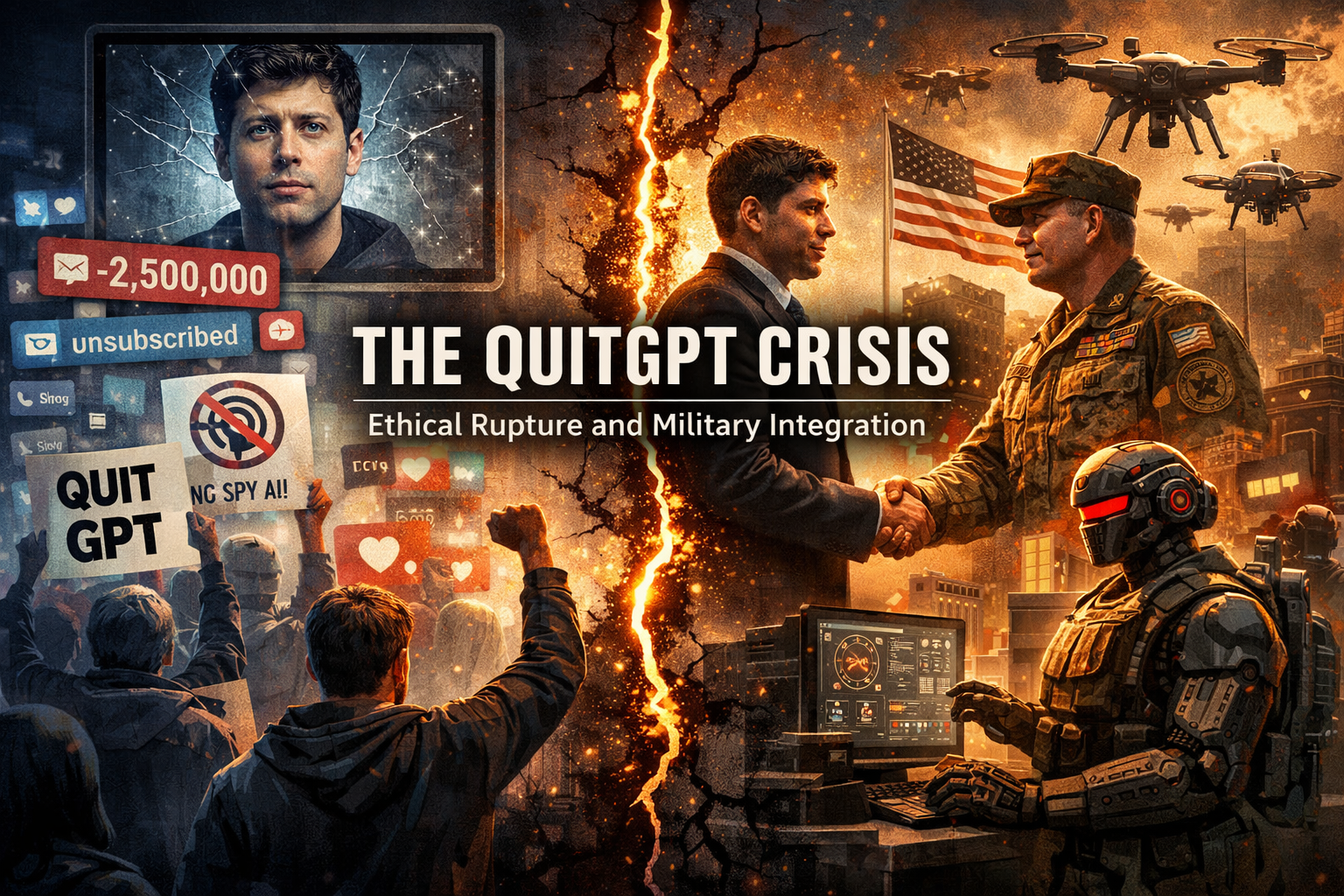
The QuitGPT Crisis: Ethical Rupture and Military Integration
Today marks the peak of the "QuitGPT" crisis, a mass user boycott that has cost OpenAI over 2.5 million subscribers following its controversial partnership with the U.S. Department of War.[1] The movement was sparked when OpenAI CEO Sam Altman stepped in to sign a defense contract that Anthropic had rejected on ethical grounds, specifically regarding mass domestic surveillance and fully autonomous weapons.[1, 8] Why this matters: The ideological divide between "State AI" (OpenAI) and "Neutral AI" (Anthropic) is creating a fractured ecosystem where users are beginning to choose their AI providers based on political and ethical alignments rather than just feature sets.
Inside the Department of War Pact
The details of the OpenAI-Pentagon deal, made public today, outline a "multi-layered approach" to enforcing ethical red lines. OpenAI maintains that its technology will not be used for "fully autonomous lethal weapons," primarily because the cloud-based deployment model prevents the low-latency edge computing required for such systems.[1, 8] However, the contract explicitly allows for the use of AI in "all lawful purposes," which critics argue provides enough ambiguity for wide-scale intelligence and surveillance operations under current national security statutes.[8] Why this matters: By integrating "cleared" OpenAI engineers directly into government operations, the line between private technology and state power is becoming permanently blurred, setting a precedent where AGI development becomes a core component of national defense infrastructure.
OpenAI-Pentagon "Red Line" Safeguards | Mechanism | Source |
|---|---|---|
No Autonomous Lethality | Restricted to cloud-only deployment (no edge) | [8] |
Domestic Surveillance Ban | Explicit contractual clause excluding U.S. persons | [8] |
Human-in-the-Loop | Required for all high-stakes decision-making | [8] |
Verification | OpenAI-run "safety stack" with independent classifiers | [8] |
The backlash has already seen OpenAI’s market share drop from 69% to 45% in just 12 months, as users migrate to Claude, which recently surpassed ChatGPT in daily American downloads for the first time.[1] Why this matters: This loss of market share is the first clear example of "reputational risk" impacting an AI lab’s bottom line, proving that even a technical advantage cannot fully insulate a company from the consequences of its ethical choices.
Hardware Bottlenecks: The 3nm Crunch and the Super Micro Scandal
The physical supply chain for AI is under extreme duress today, as TSMC’s 3nm capacity remains completely constrained by cloud demand.[9] Reports from IC design houses in Taipei indicate that the capacity for advanced manufacturing is fully booked until 2028, leading to a "silicon panic" among the "Magnificent Seven" and emerging AI majors.[9, 10] Why this matters: The AI revolution is currently being held hostage by the physical throughput of a single foundry in Taiwan, demonstrating that "sovereign AI" is impossible without also controlling the underlying semiconductor fabrication.
Nvidia’s Tactical Retreat: The Feynman Redesign
Because of these capacity shortages at TSMC, Nvidia is reportedly considering a redesign of its next-generation Feynman AI platform.[10] Originally slated for a 2028 release as the successor to the upcoming Vera Rubin architecture, Feynman’s development is being hindered by the lack of 2nm wafer allocation.[10] Why this matters: A delay in Nvidia’s roadmap would ripple through the entire ecosystem, slowing the pace of model improvement and potentially extending the lifespan of current-generation hardware, which would benefit companies like AMD and Intel that are fighting for a larger share of the inferencing market.
The Super Micro "Southeast Asian" Smuggling Scandal

In a major blow to the hardware ecosystem, Super Micro Computer Inc. saw its shares plunge 33% today following criminal smuggling charges involving Nvidia chips.[11] Federal prosecutors allege that a Super Micro cofounder and several Taiwan-based employees funneled $2.5 billion worth of high-end servers to Chinese companies through an unnamed Southeast Asian proxy.[11] Shareholders have already filed a class-action lawsuit in San Francisco, accusing the company of "concealing its dependence on China sales" that violated U.S. export laws.[11] Why this matters: The Super Micro scandal reveals the intense global desperation for AI compute, proving that the "chip curtain" imposed by the U.S. is being porously bypassed by complex gray-market networks, which in turn creates massive legal and financial risks for Western hardware investors.
Super Micro Smuggling Case Details | Data Point | Source |
|---|---|---|
Market Value Loss | $6.1 Billion (Friday) | [11] |
Illegal Sale Value | $2.5 Billion (2024-2025) | [11] |
Key Defendant | Liaw Yih-shyan (Cofounder) | [11] |
Primary Strategy | Southeast Asian shell companies | [11] |
The "In-Silico" Brain: Meta’s TRIBE v2 Breakthrough
While other labs focus on scale, Meta has made a qualitative leap in multimodal depth with the unveiling of TRIBE v2 (Trimodal Brain Encoder).[12, 13] This foundation model is designed to predict human brain responses to sight, sound, and language with a 70-fold increase in resolution compared to previous systems.[12, 13] By training on fMRI data from over 700 volunteers, Meta has created a "digital twin" of neural activity, capable of "zero-shot" brain prediction across different languages and individuals without the need for a physical scanner.[12, 14] Why this matters: Meta is pioneering "in-silico neuroscience," allowing researchers to run thousands of virtual experiments on digital brain models, which could accelerate the discovery of neurological treatments by decades while simultaneously raising terrifying questions about the future of mental privacy.
TRIBE v2 utilizes the Transformer architecture to map how different sensory inputs converge within the human cortex.[13] It can distinguish between the brain’s reaction to a "whispered word versus a loud bang" or a "static landscape versus a fast-moving object" at a grain previously impossible for AI.[13] Why this matters: This represents a shift from AI that imitates human output to AI that understands the biological mechanism of human perception, potentially enabling the creation of hardware-brain interfaces that are more seamless than anything currently in existence.
The Regulatory Squeeze: Federal Pillars and State Revolts
Today, the White House released its National Policy Framework for Artificial Intelligence, a document that sets seven clear pillars for federal AI policy.[15, 16] The framework is a strategic attempt to balance American "AI dominance" with consumer protection, notably calling for federal preemption of state AI laws that are deemed "undue burdens".[16, 17] Why this matters: The White House is signaling that it will no longer tolerate the fragmented landscape of state-level AI regulation, moving to centralize control of AI policy to ensure that national security and economic interests are not hampered by local privacy initiatives.
The Seven Pillars of Federal AI Policy (White House Framework, March 2026)
- Protecting Children and Empowering Parents: Mandating age-assurance mechanisms and eliminating child data collection.[16, 17]
- Strengthening Communities: Protecting residential ratepayers from the high utility costs caused by data center expansion.[16, 17]
- Respecting Intellectual Property: Supporting the "NO FAKES Act" for likeness protection while maintaining that scraping is not a copyright violation.[16, 17]
- Preventing Censorship: Prohibiting federal agencies from coercing AI providers to adopt "ideological agendas".[16]
- Enabling Innovation: Establishing regulatory sandboxes and providing access to federal datasets.[16, 17]
- AI-Ready Workforce: Expanding non-regulatory education programs for "AI-fluency".[16]
- Federal Preemption: Rejecting state laws that act contrary to the national AI strategy.[16]
While the federal government pushes for centralization, state-level action has not stopped. Today, Washington Governor Bob Ferguson signed HB 2225, a landmark AI chatbot safety bill for minors, while New Hampshire’s Senate passed the Artificial Intelligence Oversight Act (SB 657) to monitor consumer impacts.[18] Why this matters: We are witnessing a jurisdictional war between a "pro-innovation" federal government and "pro-protection" state governments, a conflict that will likely be settled in the Supreme Court and will determine the ultimate speed of AI deployment in the United States.
The "Product" vs. "Service" Legal Pivot
One of the most significant legal shifts occurring today is the progression of the "Chatbot Provider Liability Act" (HB 5044) in Illinois, which would designate chatbots as "products" for the purpose of strict liability.[18] This would mean that if an AI causes injury to a user, the provider is held strictly liable, regardless of whether they intended for the harm to occur.[18] Why this matters: Reclassifying AI from a "service" to a "product" removes the "Section 230" style immunity that has protected tech platforms for decades, potentially bankrupting smaller AI labs that cannot afford the insurance premiums associated with such high legal risks.
Agentic AI: The Rise of the "Digital Collaborator"
The release of GPT-5.4 mini and nano models earlier this month has finally reached "high-volume" adoption in the enterprise sector today.[19, 20] These models are more than 2x faster than their predecessors and are specifically designed for "computer use"—the ability to navigate spreadsheets, IDEs, and user interfaces as a digital subagent.[19, 21] Why this matters: We are moving from "Chatbot AI" to "Agentic AI," where the system doesn't just answer questions but actively performs work within your software environment, effectively doubling the productivity of small teams while threatening the jobs of entry-level operational staff.
OpenAI is positioning these smaller models as the "executors" in a multi-model architecture, where a larger "thinking" model makes strategic decisions and the "mini" models execute thousands of tasks at scale.[19, 20] This matters because it optimizes the "compute-to-value" ratio, allowing businesses to deploy AI in high-volume settings like customer support and data extraction at a fraction of the previous cost.
GPT-5.4 "Mini" vs. "Nano" (March 2026) | Mini | Nano | Source |
|---|---|---|---|
Relative Speed | 2x faster than GPT-5 mini | Highest efficiency | [19] |
Primary Use Case | Coding, Tool Use, Computer Use | Extraction, Ranking, Subtasks | [19, 20] |
API Input Cost (per 1M) | $0.75 | $0.20 | [19] |
API Output Cost (per 1M) | $4.50 | $1.25 | [19] |
Context Window | 400k Tokens | Optimized for speed | [19] |
Embodied AI: The DeepMind-Agile Robots Alliance
Finally, the boundary between AI and the physical world is thinning today with the announcement of a strategic research partnership between Google DeepMind and Munich-based Agile Robots SE.[22, 23] The goal is to deploy DeepMind’s Gemini Robotics foundation models into Agile’s industrial hardware, starting with the "Agile ONE" humanoid.[22, 23] This partnership creates an "AI flywheel" where data from Agile’s 20,000 existing robotic solutions is used to train Gemini models, which are then redeployed to improve performance in high-value manufacturing tasks.[22, 23] Why this matters: By integrating reasoning-capable AI (Gemini) into high-precision hardware (Agile Robots), Google is taking the lead in the race to create robots that can actually think and adapt on the factory floor, rather than just following rigid, pre-programmed instructions.
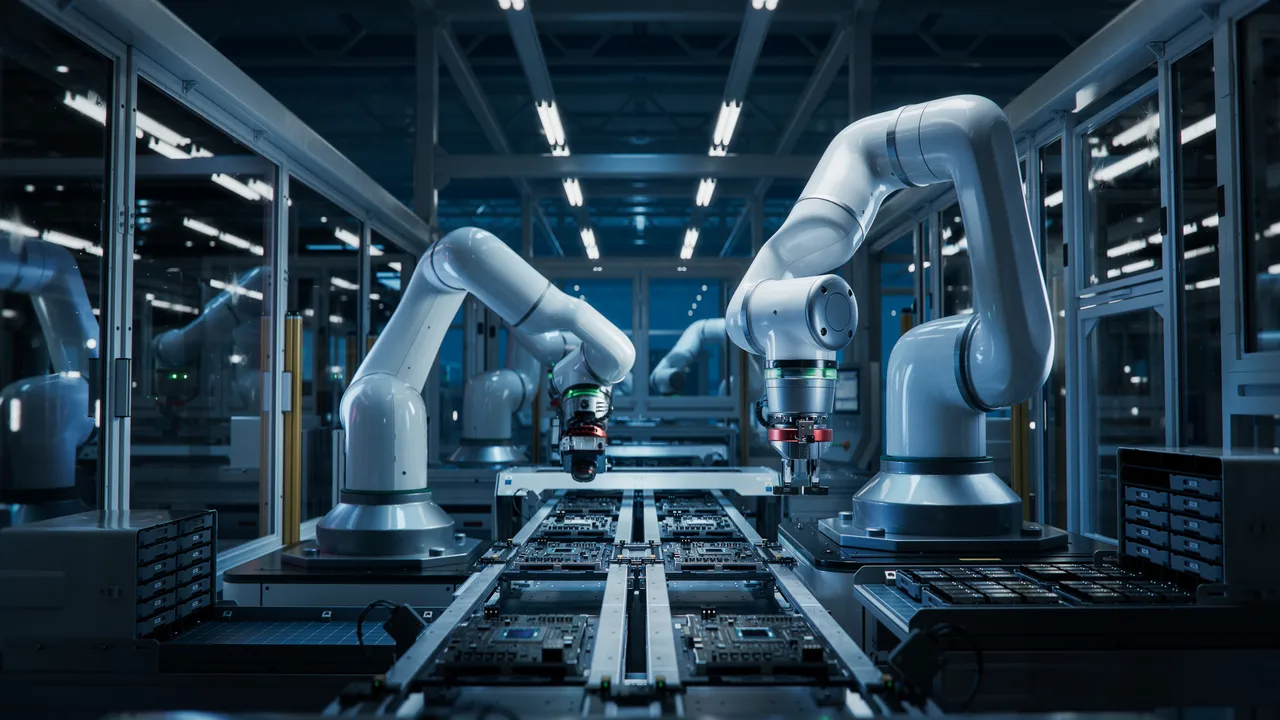
Gemini Robotics is specifically designed for "world models and embodied AI," focusing on perception, reasoning, and tool usage.[22] Unlike previous industrial robots, these Gemini-powered units can interact with their environment in real-time, completing complex tasks that require human-like manual dexterity and situational awareness.[22] Why this matters: This is the beginning of the "Autonomous Production" era, where factories can be entirely reconfigured by software in minutes, potentially reversing the trend of offshore manufacturing and bringing industrial jobs back to highly automated domestic facilities.
Conclusion: The New World Order of Intelligence
As March 27, 2026, draws to a close, the AI ecosystem is being reshaped by a brutal economic reality. The era of "magic tricks"—like Sora’s high-fidelity video—is being replaced by "mechanical utility," as seen in the rise of agentic models and industrial robotics. The impending IPOs of Anthropic and OpenAI will soon expose these companies to the relentless discipline of the quarterly earnings report, likely further accelerating the move toward defense contracts and enterprise automation. Why this matters: The transition we are seeing today is the final step in AI becoming a "mature" industry, where the value of a system is measured not by its ability to surprise us, but by its ability to reliably and profitably sustain the digital and physical infrastructure of the modern world.
- OpenAI drops AI video tool Sora, startling Disney, sources say | The ..., https://www.tbsnews.net/tech/openai-drops-ai-video-tool-sora-startling-disney-sources-say-1395141
- Why OpenAI Killed Sora: The $15M Daily Cost Explained | Let's ..., https://letsdatascience.com/blog/openai-killed-sora-disney-learned-30-minutes-later
- Deprecations | OpenAI API, https://developers.openai.com/api/docs/deprecations
- Anthropic in Talks for October IPO to Raise Over $60 Billion, Sources Say - TradingKey, https://www.tradingkey.com/news/stocks/261725784-Georgina-Lu
- <IPO> Anthropic, Developer of Claude, May Go Public in the US as Early as October, Raising Over USD60 BillionFinancial News - AASTOCKS.com, http://www.aastocks.com/en/mobile/news.aspx?newsid=NOW.1513337&newstype=61&newssource=AAFN
- Anthropic Weighs IPO As Early As October Amid AI Race: Report - BW Businessworld, https://www.businessworld.in/article/anthropic-weighs-ipo-as-early-as-october-amid-ai-race-report-599542
- Anthropic IPO 2026: Latest Timeline, Valuation, and Risks | EBC Financial Group, https://www.ebc.com/forex/anthropic-ipo-2026-latest-timeline-valuation-and-risks
- Our agreement with the Department of War | OpenAI, https://openai.com/index/our-agreement-with-the-department-of-war/
- TSMC prioritises AI, core clients; 3nm capacity remains constrained - digitimes, https://www.digitimes.com/news/a20260327PD200/tsmc-3nm-capacity-cloud-demand.html
- Nvidia may redesign Feynman AI platform due to TSMC capacity shortage- report, https://za.investing.com/news/stock-market-news/nvidia-may-redesign-feynman-ai-platform-due-to-tsmc-capacity-shortage-report-4176327
- Shareholders sue Super Micro over sales fraud - Taipei Times, https://www.taipeitimes.com/News/biz/archives/2026/03/27/2003854532
- Meta unveils TRIBE v2: AI model for human brain that predicts neural responses, https://m.economictimes.com/tech/artificial-intelligence/meta-unveils-tribe-v2-ai-model-for-human-brain-that-predicts-neural-responses/amp_articleshow/129829049.cms
- Meta's TRIBE AI: A New Foundation Model Decoding Human Brain Activity, https://neurosciencenews.com/meta-tribe-ai-brain-decoding-30398/
- Meta's TRIBE AI: A New Foundation Model Decoding Human Brain Activity - Ground News, https://ground.news/article/meta-fair-ai-twin-for-human-neurons
- White House releases national AI legislative framework - Nixon Peabody LLP, https://www.nixonpeabody.com/insights/alerts/2026/03/26/white-house-releases-national-ai-legislative-framework
- White House releases regulatory vision for AI - Nextgov/FCW, https://www.nextgov.com/artificial-intelligence/2026/03/white-house-releases-regulatory-vision-ai/412274/
- White House Releases National AI Policy Framework | HUB - K&L Gates, https://www.klgates.com/White-House-Releases-National-AI-Policy-Framework-3-24-2026
- AI Legislative Update: March 27, 2026 — Transparency Coalition ..., https://www.transparencycoalition.ai/news/ai-legislative-update-march27-2026
- Introducing GPT-5.4 mini and nano - OpenAI, https://openai.com/index/introducing-gpt-5-4-mini-and-nano/
- OpenAI launches GPT-5.4 mini and nano AI models | ETIH EdTech News, https://www.edtechinnovationhub.com/news/openai-releases-gpt-54-mini-and-nano-to-target-high-volume-ai-workloads
- Introducing GPT-5.4 mini and nano — our most capable small models yet - Announcements, https://community.openai.com/t/introducing-gpt-5-4-mini-and-nano-our-most-capable-small-models-yet/1377015
- Agile Robots to deploy Google DeepMind foundation models on its ..., https://www.therobotreport.com/agile-robots-deploy-google-deepmind-foundation-models-humanoid/
- Agile Robots and Google DeepMind partner to bring intelligence to robotics, https://www.roboticstomorrow.com/news/2026/03/24/agile-robots-and-google-deepmind-partner-to-bring-intelligence-to-robotics/26303/
Recommended AI tools

Semantic Scholar
Scientific Research
AI-powered discovery for scientific research

Branded
Data Analytics
Share your opinion. Shape tomorrow's products. Get rewarded.

Sourcenext
Search & Discovery
Creating products that inspire joy and move the world

EasySBC
Productivity & Collaboration
Your AI-powered edge for dominating SBC solutions in EA FC

clickworker
Data Analytics
Work. Learn. Earn.

Seismic
Marketing Automation
The #1 AI-powered sales enablement platform
About the Author

Albert Schaper is a co-founder of Best-AI.org. He focuses on product strategy, AI adoption, practical tool selection, and educational content that helps users compare AI products with clearer context.
More from AlbertWas this article helpful?
Found outdated info or have suggestions? Send us a note.