Multi-Model AI Consensus and Persistent Workspaces: A New Era for Enterprise LLMs

From Chatbots to Boardrooms: The Rise of Multi-Model AI Consensus in the Enterprise
The honeymoon phase of generative AI is officially over. Enterprise leaders are no longer impressed by a simple interface that can summarize an email or draft a generic blog post. Today, organizations demand measurable ROI, strict risk mitigation, and deep strategic value. Yet, most businesses are still relying on a flawed architectural approach: the single-model prompt.
Whether an organization uses OpenAI, Anthropic, or Google, relying on a single Large Language Model (LLM) creates a critical single point of failure. Every foundational model has its own unique architectural biases, training data gaps, and propensity for "hallucinations." In high-stakes corporate environments - such as financial modeling, legal structuring, or market entry strategy - accepting the first output of a single AI model is not just inefficient; it is a corporate liability.
The "Ensemble" Approach: Moving from Oracle to Council
To solve this, the enterprise software market is borrowing a concept from advanced data science: ensemble learning. Instead of relying on one algorithm, you combine several to reach a more accurate conclusion.
At the user level, this translates to robust platforms that replace the standard chat window with a dynamic, multi-agent workspace. By leveraging true multi-model AI collaboration, users can route a single complex strategic query through multiple top-tier foundational models simultaneously.
Imagine pitting the highly nuanced, logical reasoning of Claude against the vast data-synthesizing capabilities of Gemini and the creative problem-so
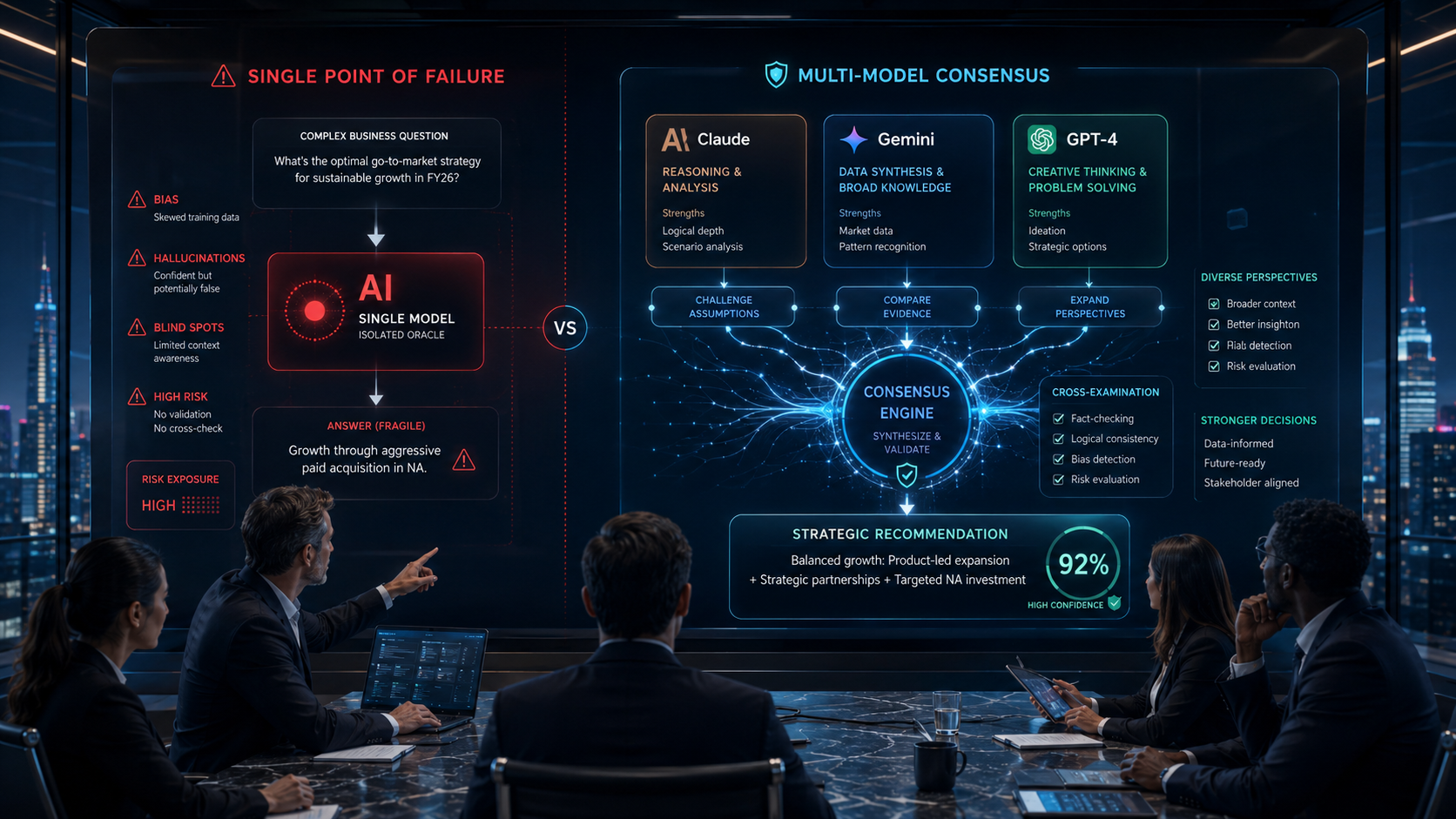
lving of GPT-4. However, generating three separate answers only creates cognitive overload for the human operator. The true breakthrough is active consensus. The most advanced workspaces now force these models to debate each other, cross-examine logical fallacies, vote on the optimal pathways, and synthesize a single, bulletproof recommendation. It is the equivalent of assembling a board of world-class experts to stress-test your business strategy in real-time.
Stateful AI: Curing "Contextual Amnesia"
The second major limitation of the "chat wrapper" era is structural amnesia. Enterprise work is inherently stateful. It spans across weeks, involves shifting project scopes, and requires referencing deep, complex documentation. A standard chatbot forgets the intricacies of your project the moment the session times out.
To securely scale AI within corporate walls, the ecosystem is shifting toward persistent workspaces. By replacing isolated chats with dedicated "Project Documents" and long-term memory modules, the AI evolves from a stateless answering machine into a continuous collaborator. If a project manager pivots a strategic directive on day 14, the workspace seamlessly applies that updated context to the slide deck it generates on day 25.
The Verdict: Collaboration over Computation
The AI arms race is no longer simply about which single model has the highest parameter count. The durable product moat is operational: how well can a platform route tasks, maintain persistent context, and mitigate risk through debate?
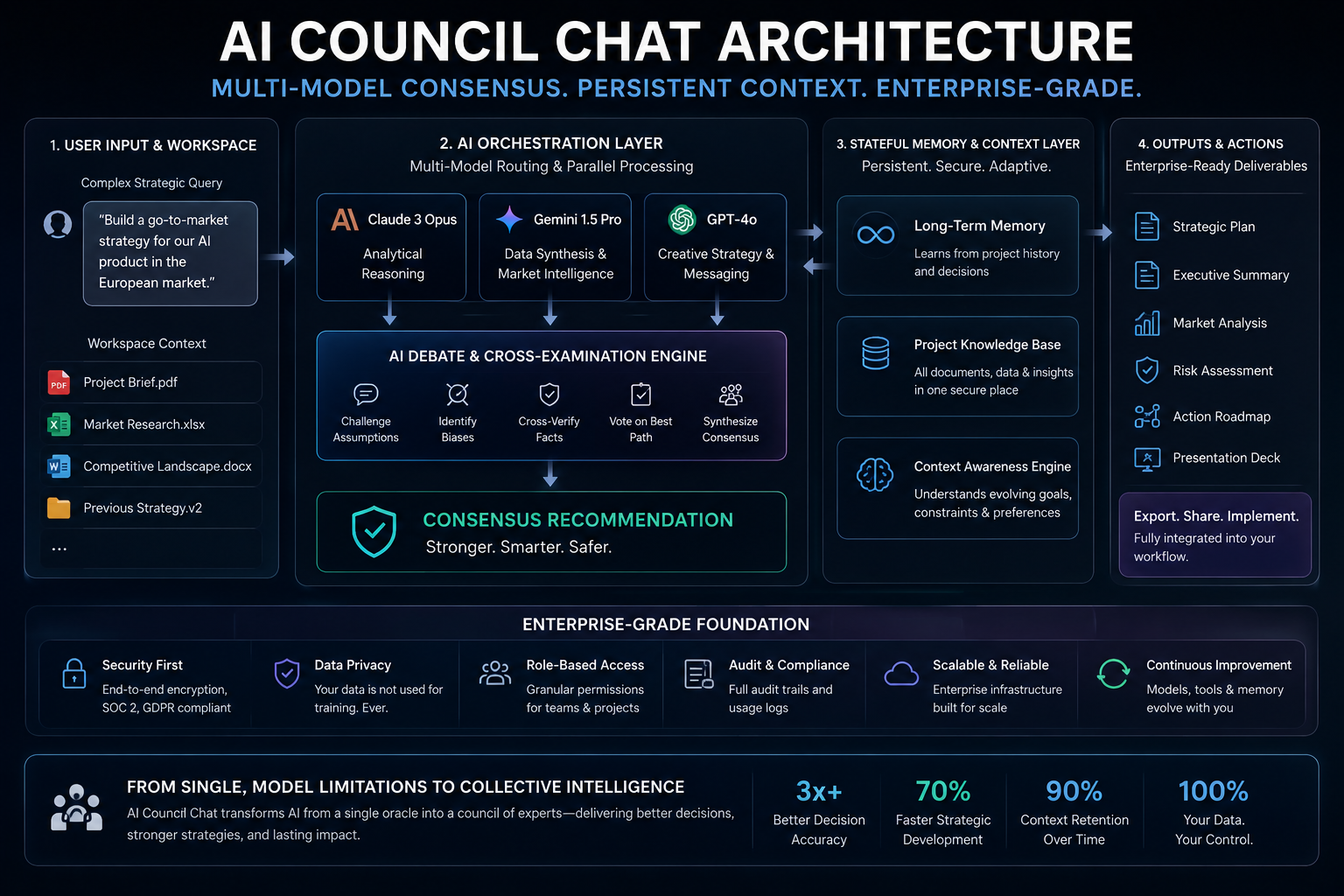
Business leaders looking to future-proof their workflows must adopt platforms that treat AI as a collaborative ecosystem. Workspaces like AI Council Chat are leading this enterprise shift, providing the exact multi-model consensus, persistent memory, and strategic alignment that corporate clients require to operate intelligently at scale. The future of enterprise productivity isn't a single oracle - it's a council.
Recommended AI tools

ChatGPT
Conversational AI
AI research, productivity, and conversation—smarter thinking, deeper insights.

Perplexity
Search & Discovery
Clear answers from reliable sources, powered by AI.

Claude
Conversational AI
Your trusted AI collaborator for coding, research, productivity, and enterprise challenges

DeepSeek
Conversational AI
Efficient open-weight AI models for advanced reasoning and research

Magnific
Image Generation
Generate on-brand AI images from text, sketches, or photos—fast, realistic, and ready for commercial use.

Google Antigravity
Productivity & Collaboration
Build in the agent-first era
About the Author

Albert Schaper is a co-founder of Best-AI.org. He focuses on product strategy, AI adoption, practical tool selection, and educational content that helps users compare AI products with clearer context.
More from AlbertWas this article helpful?
Found outdated info or have suggestions? Send us a note.