The Intelligence Infrastructure Supercycle: International Daily AI Press Digest – 2 April 2026

The artificial intelligence landscape on 2 April 2026 has been defined by a tectonic consolidation of capital and a fundamental shift in the architectural focus of the world's leading technology entities. As the global economy pivots toward an intelligence-first framework, the news today highlights a staggering 122 billion investment into OpenAI, a record-breaking 1.75 trillion valuation for SpaceX’s integrated orbital AI infrastructure, and a critical security crisis at Anthropic that has exposed the internal blueprints of the world’s most advanced coding agents. These developments signal that the era of AI experimentation has officially concluded, replaced by a high-stakes "supercycle" where sovereign-scale infrastructure and autonomous reasoning capabilities are the primary currencies of power. Why this matters.
OpenAI’s Financial Hegemony and the Pursuit of AGI
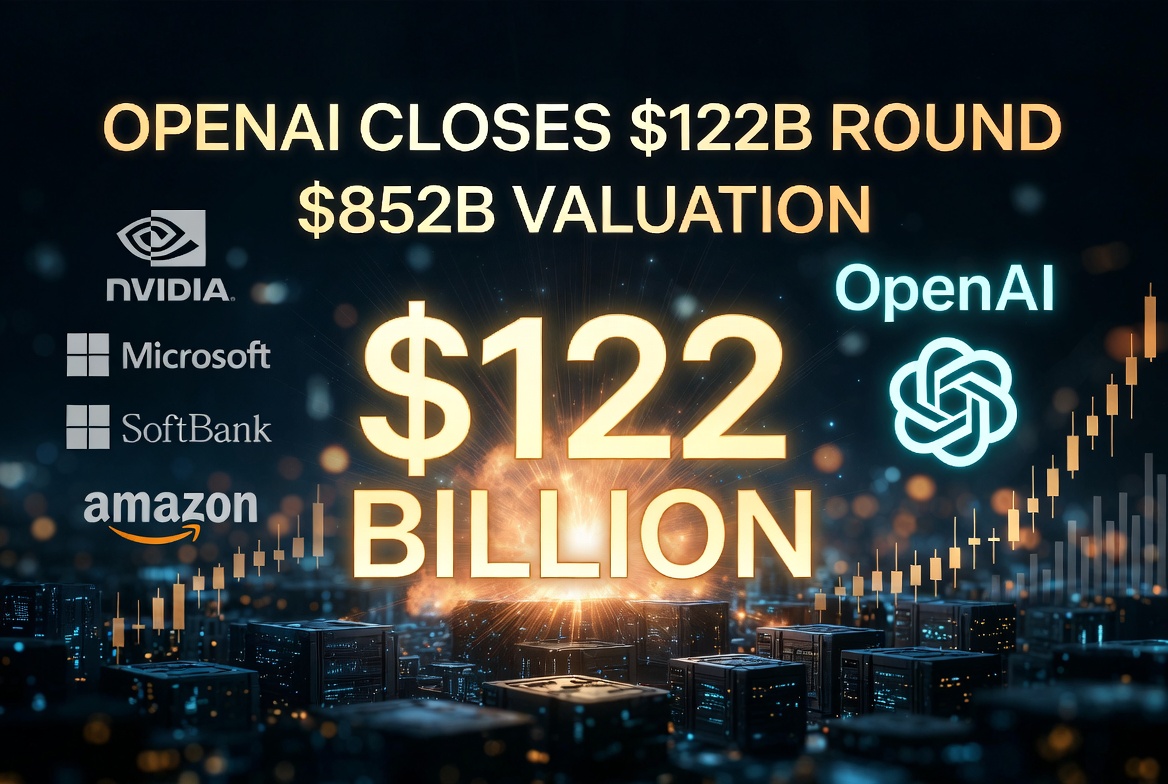
OpenAI has formally closed its latest funding round, securing 122 billion in committed capital at a post-money valuation of 852 billion.[1, 2] This capital injection, the largest in the history of the private technology sector, was anchored by strategic heavyweights including Amazon, Microsoft, Nvidia, and SoftBank.[1, 2] The participation of individual investors, who contributed approximately 3 billion through specialized bank channels, alongside the inclusion of OpenAI in several ARK Invest ETFs, reflects a unique democratization of high-stakes AI equity.[2, 3] OpenAI now ranks as the world’s most valuable startup, worth more than all but twelve companies in the S&P 500, signaling its transition from a research lab into a core utility for the global digital economy.[3] Why this matters.
The company’s financial performance supports this massive valuation, with OpenAI now generating a staggering 2 billion in monthly revenue.[1, 2] This growth is four times faster than the trajectories seen by Alphabet or Meta during the early internet and mobile eras.[2] A significant driver of this revenue is the enterprise sector, which now accounts for more than 40% of total revenue and is on track to reach parity with the consumer segment by the end of 2026.[2] ChatGPT itself has achieved a milestone of 900 million weekly active users, while the platform’s integrated search engine has seen usage triple over the past twelve months.[1, 2] Why this matters.
Strategic pivots accompanied this financial announcement, most notably the decision to shut down the viral video-generation platform Sora.[4] OpenAI President Greg Brockman confirmed that the company is reallocating massive compute resources toward the pursuit of Artificial General Intelligence (AGI) and the development of the "Spud" model, rumored to be GPT-5.5.[4] Brockman described Spud as possessing a "big model smell"—a high level of intuitive reasoning that allows users to execute complex tasks without iterative prompting.[4] The company is also developing a "superapp" intended to integrate ChatGPT, web browsing, coding via the Codex agent, and persistent agentic capabilities.[1, 4] Why this matters.
OpenAI’s monetization strategy has also expanded into advertising, with a pilot for non-premium users reaching a 100 million annualized revenue run rate (ARR) in just six weeks.[2, 3] This move into ads, combined with the rapid growth of the API business—which now processes more than 15 billion tokens per minute—illustrates a multi-pronged approach to maintaining the company’s capital-intensive operations.[2] The decommissioning of Sora, despite a billion-dollar deal with Disney, underscores the absolute priority being placed on raw reasoning power over creative multi-modal tools.[4] Why this matters.
OpenAI and Anthropic: Comparative Economic Metrics 2 April 2026
Metric | OpenAI | Anthropic |
|---|---|---|
Post-Money Valuation | 852 Billion [2] | 600 Billion [3] |
Annualized Revenue Run Rate | 24 Billion [2] | 14 Billion [3] |
Funding Round Size (Latest) | 122 Billion [1] | 30 Billion [1] |
Revenue Growth (YoY) | 400% [2] | 1,400% [3] |
Primary Commercial Focus | Consumer Superapp & Search [1] | Enterprise Coding Agents [3] |
Compute Partners | Microsoft, Nvidia [2] | Amazon, Google [1] |
Anthropic’s Credibility Crisis: The Claude Code Leak
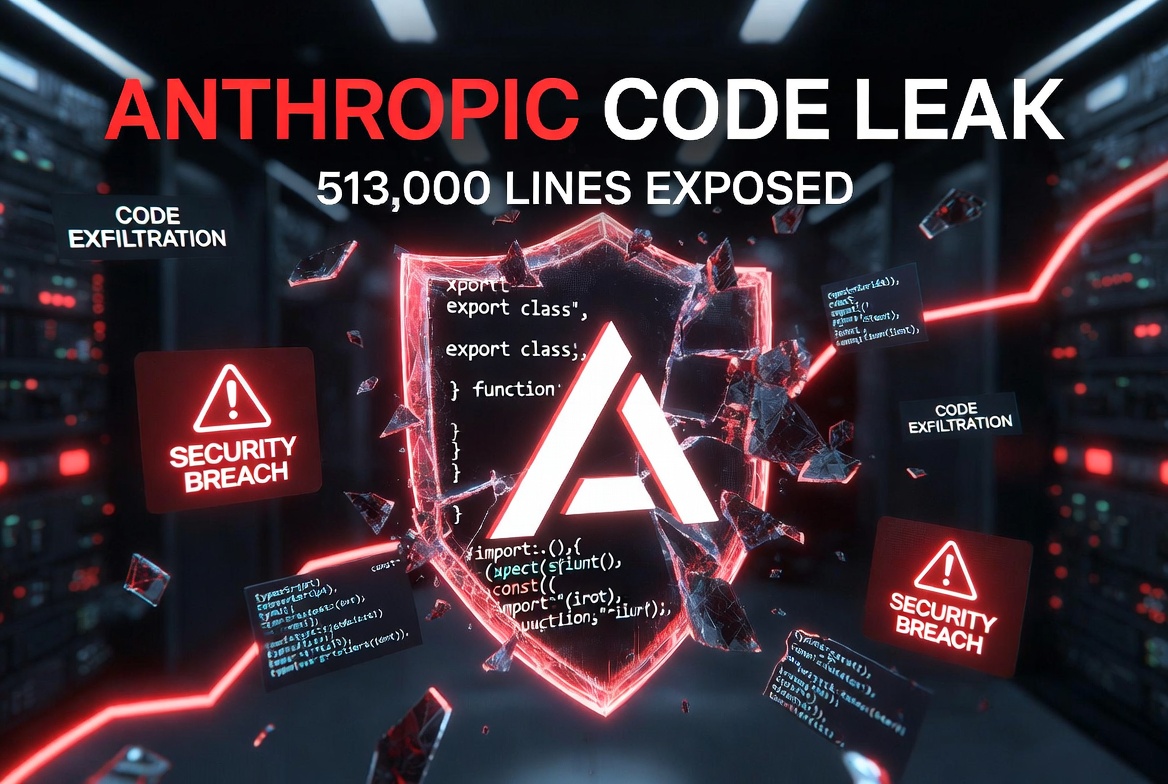
While OpenAI celebrated its capitalization, its primary rival, Anthropic, faced a catastrophic breach of its intellectual property on 2 April 2026.[5, 6] A packaging error involving the Bun runtime led to the accidental exposure of the full, unobfuscated source code for Claude Code—Anthropic’s flagship terminal-based AI coding assistant—in a public npm release.[6, 7] The leaked 59.8 MB JavaScript source map file revealed approximately 513,000 lines of TypeScript, exposing the internal logic, client-side agent harnesses, and previously unannounced features.[6, 8] Why this matters.
The leak has provided a rare, unintentional look at the future of Anthropic’s product roadmap, including details on a persistent agent codenamed "Kairos".[5] Kairos is designed to operate 24/7 in the background, autonomously performing tasks on behalf of the user, effectively bridging the gap between a chatbot and a fully autonomous digital employee.[5] The codebase also contained references to "Proactive" and "Dream" modes, suggesting that Anthropic is developing systems capable of ongoing background activity and long-running support for complex developer tasks.[7] Why this matters.
In the immediate aftermath of the leak, Anthropic has engaged in a massive cleanup effort, issuing copyright takedown notices for over 8,000 copies and forks of the source code on GitHub.[5, 8] Despite these efforts, security researchers note that the code has already been widely mirrored and is being analyzed by both competitors and threat actors.[6, 8] Malicious versions of the "leaked" code have already surfaced, used as social engineering lures to distribute Vidar and GhostSocks malware to unsuspecting developers.[6] Why this matters.
The timing of the leak is particularly damaging for Anthropic, which has recently seen its valuation soar to 600 billion amid scorching-hot demand for its enterprise coding tools.[3, 9] Claude Code has been the primary driver of Anthropic’s 14 billion annualized revenue, and the exposure of its internal architecture could erode the company's competitive advantage in the lucrative "AI for developers" market.[3, 7] Analysts observe that this "human error" has created a significant credibility problem for a company that has built its brand on safety and reliability.[7] Why this matters.
Market sentiment in the secondary share space has reacted with a mix of opportunism and caution. Prior to the leak, demand for Anthropic shares was outpacing OpenAI on platforms like Augment and Hiive, with investors betting that Anthropic’s lower valuation offered a better risk-reward profile ahead of a projected Q4 2026 IPO.[3, 9] However, the security incident has raised questions about the operational maturity of the firm as it prepares for public markets.[7] Why this matters.
Google DeepMind’s Scientific Breakthroughs and the Aletheia Agent
Google DeepMind has unveiled a major upgrade to Gemini 3 Deep Think, its specialized reasoning mode designed to solve the world's most complex scientific and engineering challenges.[10, 11] This update includes the introduction of Aletheia, an autonomous mathematical research agent that utilizes a generation-verification-revision cycle to solve problems without human intervention.[10, 12] Aletheia’s most critical feature is its ability to "admit failure," a mechanism that has significantly improved research efficiency by preventing the delivery of incorrect but confident-sounding solutions.[10, 12] Why this matters.
In a landmark demonstration of AI capability, Google published two papers on arXiv detailing how Gemini 3 Deep Think solved 18 open problems in mathematics, physics, and computer science that had previously stumped human experts.[10, 12] These included breakthroughs in arithmetic geometry, where the model autonomously calculated structure constants called "eigenweights," and the resolution of deadlocks in classic computer science problems like "Max-Cut" and the "Steiner Tree".[10, 12] The model achieved this by pulling tools from unrelated branches of continuous mathematics to solve discrete algorithmic puzzles.[10] Why this matters.
Technical benchmarks for Gemini 3 Deep Think show an unprecedented leap in reasoning quality. The model scored 84.6% on the ARC-AGI-2 benchmark, verified by the ARC Prize Foundation, and achieved a staggering Elo of 3455 on Codeforces, placing it at the gold-medal level for competitive programming.[11, 12] Furthermore, it scored 90% on the IMO-ProofBench Advanced test, demonstrating that its scaling laws hold as it moves from Olympiad-level problems toward PhD-level exercises.[10, 12] Why this matters.
To support these advanced models, Google Research introduced TurboQuant, an extreme compression algorithm presented at ICLR 2026.[13] TurboQuant addresses the memory overhead in vector quantization by using a two-stage process: "PolarQuant" for high-quality compression and "Quantized Johnson-Lindenstrauss" (QJL) as a mathematical error-checker.[13] In testing, TurboQuant achieved optimal scoring in dot product recall while minimizing the memory footprint of the key-value (KV) cache, a critical bottleneck for long-context AI models.[13] Why this matters.
Google is also aggressively integrating these capabilities into the education sector. At the BETT 2026 conference, the company announced an expanded partnership with Khan Academy to power an AI "Writing Coach" that guides students through structure and thesis development rather than simply writing essays for them.[14] Additional updates include the integration of Gemini into Google Classroom to summarize student progress and the launch of no-cost SAT practice tests built directly into the Gemini interface.[14] Why this matters.
Gemini 3 Deep Think vs. Legacy Models: Technical Benchmarks
Benchmark Category | Gemini 3 Deep Think (2 April 2026) | GPT-5.2 (Legacy) | Claude Opus (Legacy) |
|---|---|---|---|
ARC-AGI-2 Score | 84.6% [12] | 52.9% [12] | 68.8% [12] |
Codeforces Elo Rating | 3455 [11] | Undisclosed | Undisclosed |
IMO-ProofBench Advanced | 90.0% [12] | 45.1% [12] | Undisclosed |
Cost Per ARC Task | $13.62 [12] | $77.16 [12] | Undisclosed |
Scientific Problems Solved | 18 [10] | 0 | 0 |
The Hardware Arms Race: Meta’s Custom Silicon and Nvidia’s Vera Rubin
The competition for hardware dominance has reached a new fever pitch as Meta Platforms unveiled four generations of custom AI chips—the MTIA 300, 400, 450, and 500—designed to power its ranking, recommendation, and generative AI workloads.[15, 16] These application-specific integrated circuits (ASICs) are built in collaboration with Broadcom and manufacturing partner TSMC to reduce Meta's dependence on external vendors like Nvidia.[16, 17] The MTIA 400 is already in the process of deployment, while the 450 and 500 models, optimized for GenAI inference, are slated for mass deployment in 2027.[18, 19] Why this matters.
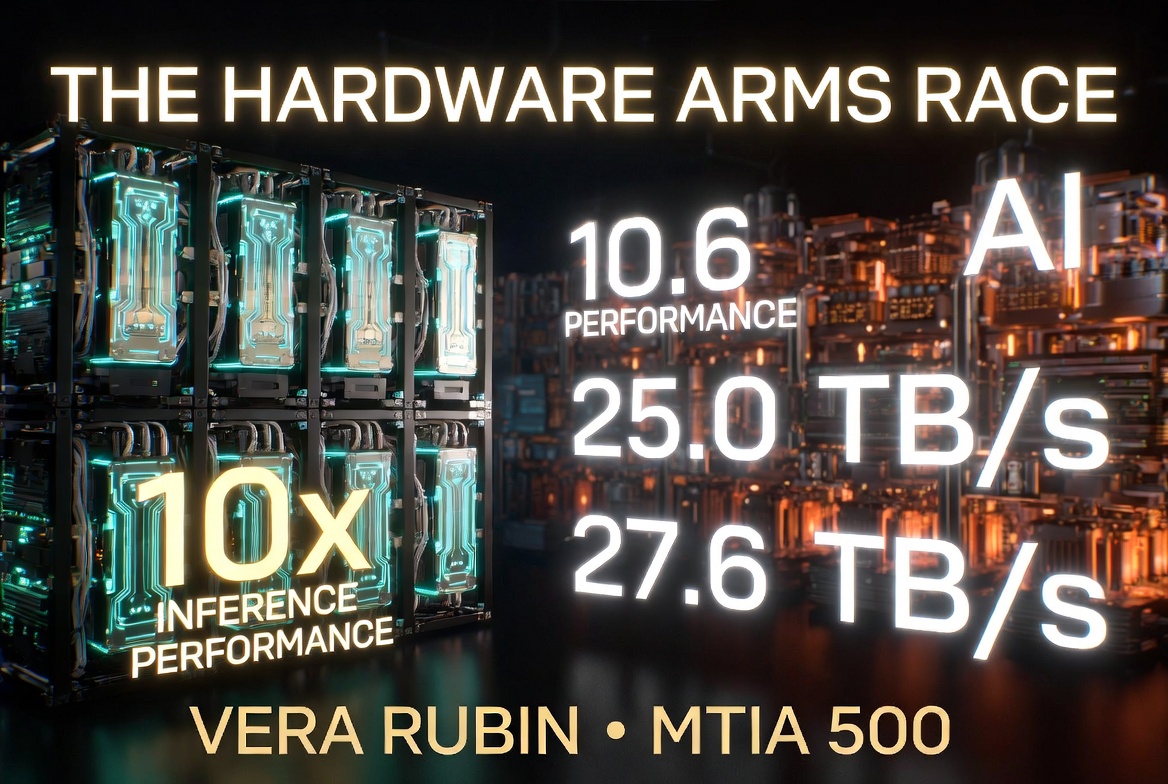
Meta’s strategy centers on optimizing for inference, which is expected to account for two-thirds of AI computing costs this year.[17] The MTIA 500 model achieves a staggering high-bandwidth memory (HBM) bandwidth of 27.6 TB/s—a 4.5x increase over the initial MTIA 300—aiming to break the memory bottleneck that currently limits large language model performance.[19] By building its own silicon, Meta can design hardware specifically for the "vibe coding" and recommendation tasks used by its 3.58 billion daily users, potentially saving billions in capital expenditure.[17, 20] Why this matters.
Nvidia, however, remains the undisputed leader of the "AI Factory" era, announcing record quarterly revenue of 68.1 billion, up 73% from a year ago.[21] At the GTC 2026 keynote, CEO Jensen Huang introduced the Vera Rubin platform, which includes six new chips that deliver a 10x reduction in inference token costs compared to the Blackwell architecture.[21] Nvidia is also expanding into space, with the "Space-1 Vera Rubin" project designed to bring AI data centers into orbit to extend accelerated computing beyond Earth's atmospheric constraints.[22] Why this matters.
The architectural battle is also seeing a new entrant through the strategic collaboration between IBM and Arm.[23] The two companies are developing new dual-architecture hardware designed to manage the high-availability and security requirements of mission-critical enterprise workloads.[23] By enabling enterprise systems to recognize and execute Arm applications within IBM’s reliable computing platforms, the partnership aims to provide organizations with the flexibility to deploy AI at scale without sacrificing data sovereignty or system stability.[23] Why this matters.
Market analysts note that while Meta’s custom chips pose a challenge to Nvidia, the overall demand for AI compute is growing so rapidly that there is ample room for multiple winners.[17] Nvidia’s strength across the entire stack—from chips like Grace Blackwell to networking tools like BlueField-5 and the Omniverse simulation platform—provides a holistic "AI Factory" model that remains difficult to replicate.[21, 22] Why this matters.
Meta Training and Inference Accelerator (MTIA) Technical Roadmap
Chip Generation | Release / Status | HBM Bandwidth | Core Optimization |
|---|---|---|---|
MTIA 300 | Deployed (2025/2026) | 6.1 TB/s [19] | Ranking & Recommendations |
MTIA 400 | Deployment Path (2026) | Undisclosed | Generative AI & Ranking |
MTIA 450 | Early 2027 | High [18] | GenAI Inference (HBM Focus) |
MTIA 500 | Late 2027 | 27.6 TB/s [19] | Extreme Throughput Inference |
SpaceX and xAI: The Trillion-Dollar Orbital Intelligence Merger
SpaceX has officially filed confidential paperwork for an initial public offering (IPO) that could value the company at 1.75 trillion, making it the most valuable aerospace and telecommunications entity in history.[24, 25] This record-breaking valuation is driven by the maturation of Starlink, which surpassed 10 billion in revenue in 2025, and a recent all-stock merger with Elon Musk’s AI venture, xAI.[24, 25] The combined entity now controls over 95% of the domestic launch market and is positioning itself as a provider of "orbital intelligence"—placing AI data centers in space to bypass terrestrial energy and cooling limitations.[25, 26] Why this matters.
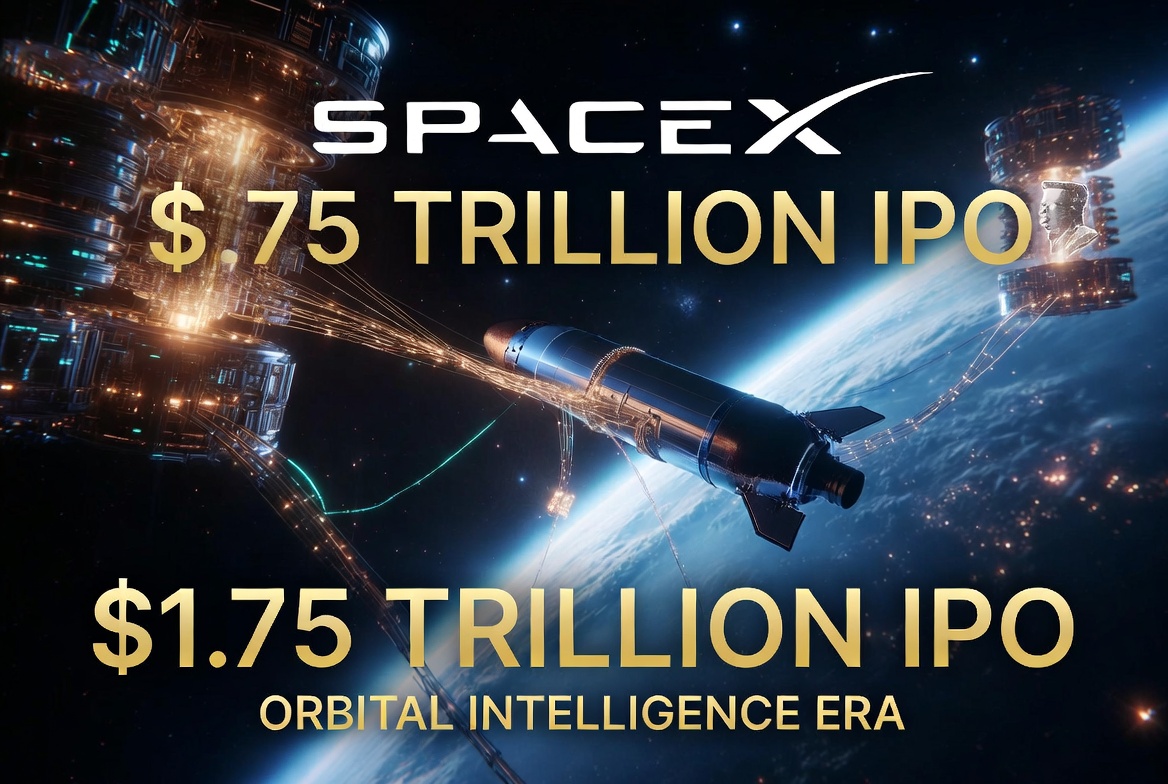
The IPO, targeted for June 2026, could raise as much as 75 billion in primary capital, eclipsing the previous global record held by Saudi Aramco.[26, 27] SpaceX is considering a dual-class share structure to preserve insider voting control for Musk, while also planning to allocate up to 30% of shares to retail investors—roughly three times the industry norm.[24, 27] Analysts from Morgan Stanley and Goldman Sachs note that the shift from a "launch provider" to a "global telecommunications and AI utility" has fundamentally changed the company’s margin profile.[25, 27] Why this matters.
In addition to its orbital assets, SpaceX is increasingly integrated with the production of Tesla’s Optimus Gen 3 humanoid robots.[24] The Fremont factory has reportedly started production of these robots, which run on Tesla’s AI5 chip and share neural network architecture with xAI’s models.[24] Musk’s vision involves a closed-loop ecosystem where SpaceX provides the connectivity and compute backbone, xAI provides the intelligence, and Optimus provides the physical labor.[24, 26] Why this matters.
The "Golden Dome" missile defense layer and lunar Starship variants represent significant future revenue streams, with the company already maintaining more than 22 billion in active government contracts.[25] However, the decision to go public is also seen as a response to the massive capital requirements of these projects, which outweigh the benefits of remaining private.[25] The upcoming weeks are critical, as a major Starship test launch in late March/early April is expected to provide the technical validation required for institutional backing.[25] Why this matters.
Industry leaders view the SpaceX IPO as a signal that the AI and space economies are no longer separate domains.[26] By merging xAI with SpaceX, Musk has created a "sovereign-scale" entity that can provide intelligence and connectivity to any point on the planet or in orbit, effectively bypassing the terrestrial bottlenecks that constrain traditional tech giants.[25, 27] Why this matters.
SpaceX Pre-IPO Financial Highlights 2026
Category | 2025 Performance | 2026 Projection |
|---|---|---|
Starlink Revenue | 10 Billion [24] | 15.9 - 24 Billion [25] |
Total Company Revenue | 15 - 16 Billion [27] | 30+ Billion [Projected] |
Net Profit | 8 Billion [27] | Undisclosed |
Starlink Subscriber Base | 9.2 Million [24] | 15 Million [Projected] |
Valuation | 800 Billion (Secondary) [27] | 1.75 Trillion (IPO Target) [25] |
Government Contracts | 22 Billion [25] | Increasing |
Geopolitical Regulation and the EU AI Act Conundrum
The regulatory landscape for artificial intelligence has entered a state of significant uncertainty following a vote by the European Parliament to delay the implementation of several key provisions of the EU AI Act.[28, 29] While the Act entered into force in August 2024, Parliament has backed a proposal to push the compliance deadlines for "high-risk" AI systems—including those involving biometrics and critical infrastructure—from August 2026 to December 2027.[29, 30] This delay is intended to give authorities time to publish necessary guidelines and standards, but it has created a "CIO conundrum" for enterprises that must now decide whether to rush toward compliance or wait for official guidance.[28] Why this matters.
Despite the proposed delays, certain rules remain in effect. Provisions concerning "prohibited" AI practices, such as social scoring and untargeted facial scraping, have been applicable since February 2025.[30, 31] Furthermore, the requirement for watermarking AI-generated content is set to become mandatory by November 2026, with the European Commission actively investigating platforms like Musk’s X for the proliferation of "nudifier" apps that generate explicit AI imagery without consent.[28, 29] Why this matters.
In the United States, the White House has released its "National AI Legislative Framework" aimed at establishing a uniform federal policy to preempt a growing "patchwork" of state-level AI regulations.[32, 33] The framework focuses on protecting U.S. competitiveness while preserving state enforcement powers in specific areas like child safety, consumer fraud, and electricity ratepayer protections.[32] This move comes as California’s AB 2013 and SB 53 have already begun imposing transparency requirements on "frontier" AI developers, requiring them to disclose training data summaries and report safety incidents.[33, 34] Why this matters.
The legal battle over AI and intellectual property also continues to escalate. In the UK, the government is expected to publish reports on AI and copyright by mid-March 2026, while the Court of Appeal is set to hear a major secondary copyright infringement case involving Getty Images and Stability AI.[35] These decisions will be pivotal in determining whether AI models trained on copyrighted data without explicit licensing can operate within European jurisdictions.[35] Why this matters.
For global enterprises, the "AI Security Rider" has become a new standard in the insurance industry. Cyber insurance carriers are now conditioning coverage on documented AI risk management practices, including adversarial red-teaming and model-level assessments.[33, 34] This private-sector enforcement, combined with the SEC’s focus on AI-driven threats to data integrity, means that companies cannot afford to wait for final regulatory clarity before building robust governance frameworks.[33, 34] Why this matters.
Industrial AI Pivots: Atlassian, Ford, and Beyond
The economic impact of AI is manifesting through significant corporate restructuring and the launch of high-impact vertical applications. Australian software giant Atlassian announced it is laying off 1,600 employees, or roughly 10% of its global workforce, to redirect capital toward AI development and enterprise sales.[15] CEO Mike Cannon-Brookes noted that while AI is not a direct replacement for people, it has fundamentally changed the "mix of skills" the company requires to compete in the current market.[15] Why this matters.
Ford Motor has unveiled "Ford Pro AI," an embedded assistant for commercial fleet management that analyzes over 1 billion data points daily.[15] The system, built on Google Cloud, can automate complex administrative tasks like drafting cost-reduction recommendations, potentially saving fleet managers over 23 hours per week.[15] This follows a broader trend of "Professional AI" applications replacing general-purpose chatbots in enterprise environments.[15] Why this matters.
In the venture capital space, Yann LeCun’s new startup, AMI Labs, raised 1.03 billion in Europe’s largest-ever seed round.[15] AMI Labs is focused on building "world models"—an alternative architecture to large language models that learns by understanding the physical laws of the world—targeting applications in robotics and healthcare.[15] This round, backed by Nvidia and Bezos Expeditions, signals a growing interest in non-transformer architectures for physical AI applications.[15] Why this matters.
Finally, the European Commission has launched "TraceMap," an AI platform designed to detect food fraud and contamination across member states.[15] By integrating supply chain data at speed, the tool allows authorities to identify suspicious patterns that previously took weeks to uncover manually.[15] These real-world applications demonstrate that AI is moving beyond "chat" and into the core logistics and safety systems of the global economy.[15] Why this matters.
--------------------------------------------------------------------------------
- OpenAI raises $122B in fresh funding round | The Manila Times, https://www.manilatimes.net/2026/04/02/business/foreign-business/openai-raises-122b-in-fresh-funding-round/2312695
- OpenAI raises $122 billion to accelerate the next phase of AI, https://openai.com/index/accelerating-the-next-phase-ai/
- OpenAI & Anthropic Prove the AI Revolution is Just Starting - April 1, 2026 - Zacks.com, https://www.zacks.com/commentary/2893282/openai-anthropic-prove-the-ai-revolution-is-just-starting
- OpenAI chief teases Spud model, says it is worth 2 years of research ..., https://www.indiatoday.in/technology/news/story/openai-chief-teases-spud-model-says-it-is-worth-2-years-of-research-and-major-step-toward-agi-2890463-2026-04-02
- Anthropic Can't Cover Up Its Claude Code Leak Fast Enough - Gizmodo, https://gizmodo.com/anthropic-cant-cover-up-its-claude-code-leak-fast-enough-2000740972
- Anthropic Claude Code Leak | ThreatLabz - Zscaler, Inc., https://www.zscaler.com/blogs/security-research/anthropic-claude-code-leak
- Claude Code Leak Creates New Problems for Anthropic - The National CIO Review, https://nationalcioreview.com/articles-insights/extra-bytes/claude-code-leak-creates-new-problems-for-anthropic/
- Anthropic Issues Copyright Takedowns to Scrub Claude Code Leak | PCMag, https://www.pcmag.com/news/anthropic-issues-8000-copyright-takedowns-to-scrub-claude-code-leak
- Analyst claims that his company literally could not find any institutional buyers for OpenAI's shares; Elon Musk replies, says - The Times of India, https://timesofindia.indiatimes.com/technology/tech-news/analyst-claims-that-his-company-literally-could-not-find-any-institutional-buyers-for-openais-shares-elon-musk-replies-says-not-/articleshow/129960167.cms
- Gemini Deep Think: Redefining the Future of Scientific Research - Google DeepMind, https://deepmind.google/blog/accelerating-mathematical-and-scientific-discovery-with-gemini-deep-think/
- Gemini 3 Deep Think: Advancing science, research and engineering - Google Blog, https://blog.google/innovation-and-ai/models-and-research/gemini-models/gemini-3-deep-think/
- Gemini 3 Deep Think: The AI That Solves Unsolved Scientific Problems and Dominates Benchmarks - Pasquale Pillitteri, https://pasqualepillitteri.it/en/news/286/gemini-3-deep-think-aletheia-benchmarks-discoveries
- TurboQuant: Redefining AI efficiency with extreme compression - Google Research, https://research.google/blog/turboquant-redefining-ai-efficiency-with-extreme-compression/
- BETT 2026: Google announces major AI updates to Gemini and Google Classroom, https://www.edtechinnovationhub.com/news/bett-2026-google-announces-major-ai-updates-to-gemini-and-google-classroom
- Latest AI News and AI Breakthroughs that Matter Most: 2026 | News - Crescendo.ai, https://www.crescendo.ai/news/latest-ai-news-and-updates
- Meta further diversifies beyond Nvidia as it unveils four custom AI chips | Morningstar, https://www.morningstar.com/news/marketwatch/20260311227/meta-further-diversifies-beyond-nvidia-as-it-unveils-four-custom-ai-chips
- Meta announces four custom AI chips over two years - Tech Brew, https://www.techbrew.com/stories/2026/03/12/meta-custom-silicon-ai-chips
- Meta reveals custom AI chips it says beat Nvidia - The Register, https://www.theregister.com/2026/03/12/meta_custom_chips/
- Meta announces four new MTIA chips, focussed on inference : r/LocalLLaMA - Reddit, https://www.reddit.com/r/LocalLLaMA/comments/1rrxx2f/meta_announces_four_new_mtia_chips_focussed_on/
- The latest AI news we announced in March 2026 - Google Blog, https://blog.google/innovation-and-ai/technology/ai/google-ai-updates-march-2026/
- NVIDIA Announces Financial Results for Fourth Quarter and Fiscal 2026, https://nvidianews.nvidia.com/news/nvidia-announces-financial-results-for-fourth-quarter-and-fiscal-2026
- NVIDIA GTC 2026: Live Updates on What's Next in AI, https://blogs.nvidia.com/blog/gtc-2026-news/
- IBM Announces Strategic Collaboration with Arm to Shape the ..., https://newsroom.ibm.com/2026-04-02-IBM-Announces-Strategic-Collaboration-with-Arm-to-Shape-the-Future-of-Enterprise-Computing
- SpaceX files confidentially for IPO that will rewrite the record books - Teslarati, https://www.teslarati.com/spacex-files-sec-official-ipo-june/
- SpaceX Prepares for Record-Breaking $1.75 Trillion Confidential IPO Filing in March, https://satnews.com/2026/03/01/spacex-prepares-for-record-breaking-1-75-trillion-confidential-ipo-filing-in-march/
- Elon Musk's SpaceX files initial paperwork to sell shares - The Texas Tribune, https://www.texastribune.org/2026/04/01/spacex-elon-musk-ipo-shares-public/
- SpaceX files Confidentially for IPO: What this means; and how Elon ..., https://timesofindia.indiatimes.com/technology/tech-news/spacex-files-confidentially-for-ipo-what-this-means-and-how-elon-musks-company-may-have-left-openai-and-anthropic-behind/articleshow/129965231.cms
- European Parliament votes to delay EU AI Act implementation | CIO, https://www.cio.com/article/4150989/european-parliament-delays-implementation-of-parts-of-the-eu-ai-act.html
- EU Parliament backs delaying AI Act deadlines for biometrics, high-risk applications, https://www.biometricupdate.com/202603/eu-parliament-backs-delaying-ai-act-deadlines-for-biometrics-high-risk-applications
- EU AI Act: First Rules Take Effect on Prohibited AI Systems and AI Literacy - Jones Day, https://www.jonesday.com/en/insights/2025/02/eu-ai-act-first-rules-take-effect-on-prohibited-ai-systems
- EU Regulation on AI | Insight - Baker McKenzie, https://www.bakermckenzie.com/en/insight/publications/resources/product-risk-radar-articles/eu-regulation-on-ai
- White House Publishes AI Legislative Framework to Preempt State AI Regulation, https://blog.freshfields.us/post/102mnul/white-house-publishes-ai-legislative-framework-to-preempt-state-ai-regulation
- AI Regulation in 2026: The Complete Survival Guide for Businesses, https://www.kiteworks.com/cybersecurity-risk-management/ai-regulation-2026-business-compliance-guide/
- 2026 Year in Preview: AI Regulatory Developments for Companies to Watch Out For, https://www.wsgr.com/en/insights/2026-year-in-preview-ai-regulatory-developments-for-companies-to-watch-out-for.html
- AI update for 2026 | Horizon Scanning - Slaughter and May, https://www.slaughterandmay.com/horizon-scanning/2026/digital/ai-update-for-2026/
Recommended AI tools

Lovable
Code Assistance
Build full-stack apps from plain English

Bolt.new
Code Assistance
Build full-stack apps at the speed of thought—AI-powered, browser-native, instantly deployed.

Replit
Code Assistance
Build, test & automate apps with AI—autonomously, in your browser

v0
Code Assistance
Generate full web apps from ideas in minutes—no coding required.

DataCamp
Data Analytics
Master Data & AI Skills. Learn by Doing.

NovelAI
Writing & Translation
Long-form storytelling meets anime image generation
About the Author

Albert Schaper is a co-founder of Best-AI.org. He focuses on product strategy, AI adoption, practical tool selection, and educational content that helps users compare AI products with clearer context.
More from AlbertWas this article helpful?
Found outdated info or have suggestions? Send us a note.