The Global Artificial Intelligence Ecosystem: Strategic Daily Intelligence Briefing for 25 March 2026

The Global Artificial Intelligence Ecosystem: Strategic Daily Intelligence Briefing for 25 March 2026
The artificial intelligence landscape on 25 March 2026 has transitioned from a phase of speculative generative capabilities into a period of deep industrial integration, characterized by the rise of "Physical AI," agentic autonomy, and the crystallization of a new global regulatory order. This briefing examines the pivotal shifts occurring across the hardware, software, and geopolitical layers of the AI stack, providing a comprehensive analysis of today’s most significant developments.
The Strategic Pivot: OpenAI’s Resource Realignment and the End of Sora
The most disruptive news of 25 March 2026 is the formal announcement that OpenAI has terminated its Sora video application and API, a move that signals a profound shift in the company’s long-term commercial strategy.[1, 2] Only six months after its viral debut, which promised to revolutionize the film and advertising industries, OpenAI is "saying goodbye" to the platform, citing the need to reallocate massive compute resources toward business products and robotics research.[2] This decision follows the collapse of a high-profile $1 billion partnership with Disney, which had been viewed as the definitive validation of AI video generation in mainstream media.[1, 2] The shutdown is attributed to a combination of extreme compute costs and mounting legal pressures from advocacy groups and actors' unions regarding the proliferation of nonconsensual deepfakes and "AI slop".[1] Why this matters: This strategic retreat suggests that even the most well-funded AI labs are reaching the limits of sustainable compute-scaling for consumer-facing media, forcing a prioritization of high-margin enterprise utility over viral creative tools.
The termination of Sora is not an isolated event but a tactical component of OpenAI’s recent $110 billion investment round, which valued the entity at $730 billion.[3] This capital injection, led by SoftBank, NVIDIA, and Amazon, is specifically designed to transition the company from a research-led laboratory into a global infrastructure powerhouse.[3] The focus has shifted toward "OpenAI Frontier," a platform dedicated to the creation and management of "AI coworkers" that integrate directly into enterprise workflows.[4] As part of this transition, OpenAI has acquired Promptfoo, a security and evaluation platform trusted by over 25 percent of Fortune 500 companies.[4] This acquisition allows OpenAI to build "agentic security testing" directly into the development cycle, ensuring that autonomous AI agents can operate within strict policy boundaries.[4] Why this matters: The move from generative media to agentic infrastructure indicates that the "second act" of the AI revolution will be defined by software that performs work, rather than software that creates content.
Investor | Investment Amount | Strategic Contribution |
|---|---|---|
Amazon | $50 Billion | Cloud infrastructure via Bedrock and global distribution |
NVIDIA | $30 Billion | Next-generation inference compute on Vera Rubin systems |
SoftBank | $30 Billion | Global scaling and robotics ecosystem integration |
Total | $110 Billion | Infrastructure for Frontier AGI and Enterprise Agents |
OpenAI’s pivot toward high-stakes sectors is further evidenced by its landmark agreement with the United States Department of War.[5, 6] The deal allows OpenAI to deploy its models on classified cloud networks while maintaining its own "safety stack" of technical and policy controls.[5] This partnership emerged following the breakdown of relations between the Pentagon and Anthropic, which resulted in Anthropic being designated a "Supply-Chain Risk to National Security".[7, 8] OpenAI has committed to strict "red lines," including prohibitions on using its technology for mass domestic surveillance or directing autonomous lethal weapons.[6, 9] To ensure these boundaries are respected, the deployment is restricted to cloud environments, and OpenAI has "cleared" personnel in the loop for oversight.[6] Why this matters: The integration of frontier AI into national security frameworks marks the end of the "neutral" era for AI labs, as they become critical infrastructure providers for the state’s most sensitive functions.
The Physical AI Revolution: Google DeepMind and the Robotics Ecosystem
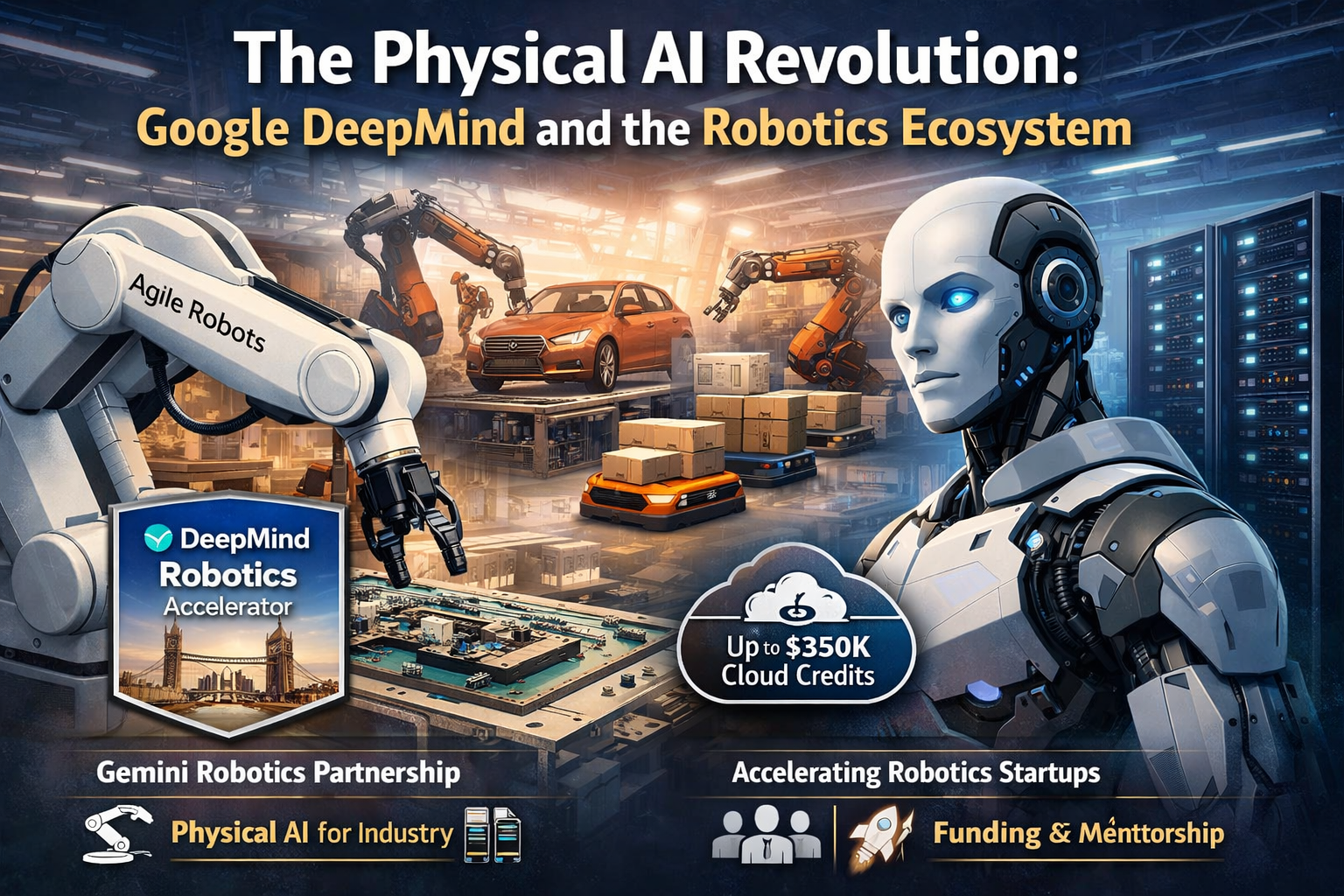
While OpenAI focuses on digital agency and defense, Google DeepMind has aggressively moved into "Physical AI"—the application of foundation models to the mechanical world.[10, 11] On 25 March 2026, Google DeepMind announced a comprehensive partnership with Agile Robots to embed Gemini Robotics foundation models into industrial hardware.[10] Agile Robots, which has already deployed over 20,000 systems globally, will leverage these models to process vision, language, and tactile data simultaneously.[10] This partnership aims to bridge the gap between digital reasoning and physical manipulation, targeting sectors such as electronics manufacturing, automotive logistics, and data center operations.[10] Why this matters: The standardization of multimodal intelligence for robotics hardware suggests a consolidation toward a unified operating system for the physical world, similar to the dominance of mobile operating systems in the previous decade.
To further catalyze this ecosystem, Google DeepMind today closed applications for its first European robotics accelerator.[11, 12] The London-based program is designed to support 10 to 15 early-stage startups building "Physical AI" solutions.[11] Participating teams receive equity-free support, direct mentorship from DeepMind’s technical staff, and up to $350,000 in Google Cloud credits.[11, 12] The initiative reflects a broader trend where major AI labs are acting as venture builders to ensure their proprietary models (like Gemini) become the foundational layer for the next generation of hardware companies.[11] Why this matters: By funding and mentoring the next generation of robotics startups, Google is ensuring that the future of industrial automation is built on its AI architecture, effectively creating a "walled garden" for physical autonomy.
Metric | Gemini 3.1 Flash-Lite Performance | Comparison to 2.5 Flash |
|---|---|---|
Response Speed | 2.5x Faster | Generational Leap in Latency |
Throughput | >360 Tokens/second | 45% Increase in Output Speed |
Input Cost | $0.25 / 1 Million Tokens | Aggressive Price Competition |
Output Cost | $1.50 / 1 Million Tokens | Optimized for Agentic Workflows |
To power these real-time physical interactions, Google has also released Gemini 3.1 Flash-Lite.[13, 14] This model is specifically optimized for extremely low-latency tasks and high-volume agentic workflows.[16, 17] It introduces a "pseudo browser" demo that can generate and render web content in milliseconds based on simple user instructions, moving AI beyond text interaction and into the realm of dynamic UI development.[13] This capability is critical for robotics and edge computing, where the delay between perception and action must be minimized.[13, 14] Why this matters: The launch of "lite" models indicates that the industry has shifted its focus from raw intelligence to operational efficiency, making real-time AI agents economically viable for the first time.
The Silicon Wars: Nvidia GTC 2026 and the Hardware-Software Convergence
The hardware foundation for this agentic future was the primary focus of NVIDIA GTC 2026 in San Jose.[18, 19] NVIDIA CEO Jensen Huang outlined a vision where hardware is no longer just a component but a fully integrated "AI Factory".[19] The centerpiece of this announcement was the Vera Rubin platform, which includes the Vera CPU, the Rubin GPU, and the newly integrated Groq 3 LPU (Language Processing Unit).[19] This platform is designed to handle the massive demands of multi-agentic reinforcement training and real-time inference, offering up to 15x faster token generation and support for models 10x larger than previous generations.[19] Why this matters: NVIDIA’s integration of diverse processing units like the Groq LPU into its stack demonstrates that the future of AI compute is no longer about general-purpose GPUs, but about specialized silicon designed for specific agentic behaviors.
Platform Component | Technical Specification | Primary Function |
|---|---|---|
Vera CPU | 88 custom "Olympus" cores | Agentic AI orchestration & reinforcement training |
Rubin GPU | Integrated HBM4 memory | Large-scale model training and high-density inference |
Groq 3 LPU | SRAM-based architecture | Ultra-low latency inference for real-time systems |
ConnectX-9 NIC | AI-native networking | Seamless inter-node communication in AI factories |
The Vera CPU represents a significant pivot for NVIDIA, as it aims to capture the orchestration layer of the AI stack.[19] With 1.2 TB/s of bandwidth and 50% faster performance than traditional rack-scale CPUs, Vera is optimized for the "reinforcement learning from human feedback" (RLHF) loops that are essential for fine-tuning agents.[19] Major OEMs, including ASUS, have already showcased liquid-cooled AI PODs built on this architecture, signaling that the industry is rapidly moving toward more power-efficient, high-density infrastructure to sustain the AI growth cycle.[20] Why this matters: As AI models become more "agentic" and require continuous reasoning rather than just single-turn responses, the CPU becomes the critical bottleneck, making NVIDIA’s "Vera" shift a defensive move to maintain its dominance over the entire rack.
The inclusion of Groq technology, following what has been characterized as either a $20 billion acquisition or a creative licensing deal, marks a strategic move to dominate the inference market.[19] Groq’s LPU is designed for high-performance, low-cost inference by using SRAM to cut latency, making it ideal for the "always-on" nature of future AI assistants.[19] NVIDIA’s hardware strategy is now clearly "multi-platform," with specific solutions for the data center, the edge (Jetson Thor), and the "AI Factory".[19, 20] Why this matters: By integrating the lowest-latency inference technology (Groq) with the highest-power training technology (Rubin), NVIDIA is effectively closing the loop on the AI lifecycle, preventing competitors from carving out a niche in real-time execution.
Agentic Commerce: Gap and the Death of the Search Bar

One of the most significant consumer-facing developments on 25 March 2026 is the launch of "Agentic Commerce" by Gap Inc. in partnership with Google Gemini.[21, 22] Gap has become the first major fashion retailer to integrate a full checkout process directly within an AI chat interface.[21, 23] Utilizing Google’s Universal Commerce Protocol (UCP), consumers can now receive personalized styling recommendations and complete their purchase without ever leaving the Gemini app.[22, 24] This integration bypasses traditional e-commerce storefronts, allowing the AI to manage product discovery, sizing, and payment in a single conversational flow.[21] Why this matters: This marks the transition from "search-based shopping" to "agent-based shopping," where the traditional website becomes a back-end logistics provider and the AI interface becomes the primary consumer relationship layer.
Component | Protocol / Technology | Function in Agentic Commerce |
|---|---|---|
Discovery | Google Gemini AI Mode | Conversational product search and styling advice |
Checkout | Universal Commerce Protocol (UCP) | Native payment processing and cart management |
Sizing | Agentic Sizing Protocol (ASP) | Natural language fit guidance (e.g., "snug in waist") |
Logistics | Unified Google Cloud Data | Real-time catalog updates and shipping integration |
A critical component of this partnership is the "Agentic Sizing Protocol" (ASP) developed by Bold Metrics.[23, 24] This protocol allows the AI agent to ask a minimal set of natural language questions to determine a shopper's unique fit preference, rather than relying on static size charts.[24] This is designed to address the $850 billion problem of online returns, which reached nearly 20% of sales in the previous year.[21] Gap’s CTO, Sven Gerjets, emphasized that this is not a novelty project but a disciplined attempt to use AI to solve "real customer problems".[22, 24] Why this matters: The move toward "token-optimized" commerce protocols indicates that the future of retail is not just about being "on the web," but about being "on the agent," where accurate data and seamless integration are the only ways to remain relevant.
The Agent Wars: Anthropic, OpenClaw, and the Battle for the Desktop
In the software layer, a fierce competition is erupting between proprietary and open-source agentic frameworks.[25, 26] Anthropic has recently updated its Claude platform to include "computer-use" capabilities, allowing the AI to take control of a user’s computer to click icons, type text, and move files.[25] This feature was bolstered by the acquisition of Vercept, a startup specializing in remote desktop operations.[25] Anthropic is positioning its "Claude Code" and "Cowork" features as a safer, more managed alternative to "OpenClaw," an open-source framework that has gained massive traction among developers.[25, 27] OpenClaw has become so popular that it has reportedly contributed to shortages of hardware like Mac Minis in regions like China, where users are setting up dedicated local hosts for their persistent agents.[25] Why this matters: The struggle between Anthropic’s "controlled environment" and OpenClaw’s "autonomous swarm" is the first major conflict over who will own the "digital worker" interface—the proprietary platforms or the open-source community.
Framework | Ownership | Philosophy | Key Security Feature |
|---|---|---|---|
Claude Code | Anthropic | Managed, Enterprise-First | Admin "allow-lists" and restricted channels |
OpenClaw | Open Source | Decentralized, Persistent | Community-driven "safety forks" |
NemoClaw | NVIDIA | Optimized Open Source | Integrated hardware-level security controls |
Anthropic’s strategy involves integrating these agents directly into messaging platforms like Discord and Telegram via their "Channels" feature.[26, 27] This allows developers to interact with their coding agents from a mobile device, effectively making the AI a persistent collaborator that can debug and compile code in the background.[26] However, this shift toward agentic persistence has raised significant security concerns, leading countries like China to restrict state-run enterprises from running OpenClaw applications on office computers.[27] In response, NVIDIA has released "NemoClaw," a software toolkit designed to add security controls to OpenClaw deployments.[25] Why this matters: As AI agents move from "chatbots" to "system operators," the security perimeter moves from the network firewall to the AI prompt, making agentic safety the most critical cybersecurity challenge of 2026.
Geopolitics and The "Manus Crisis"

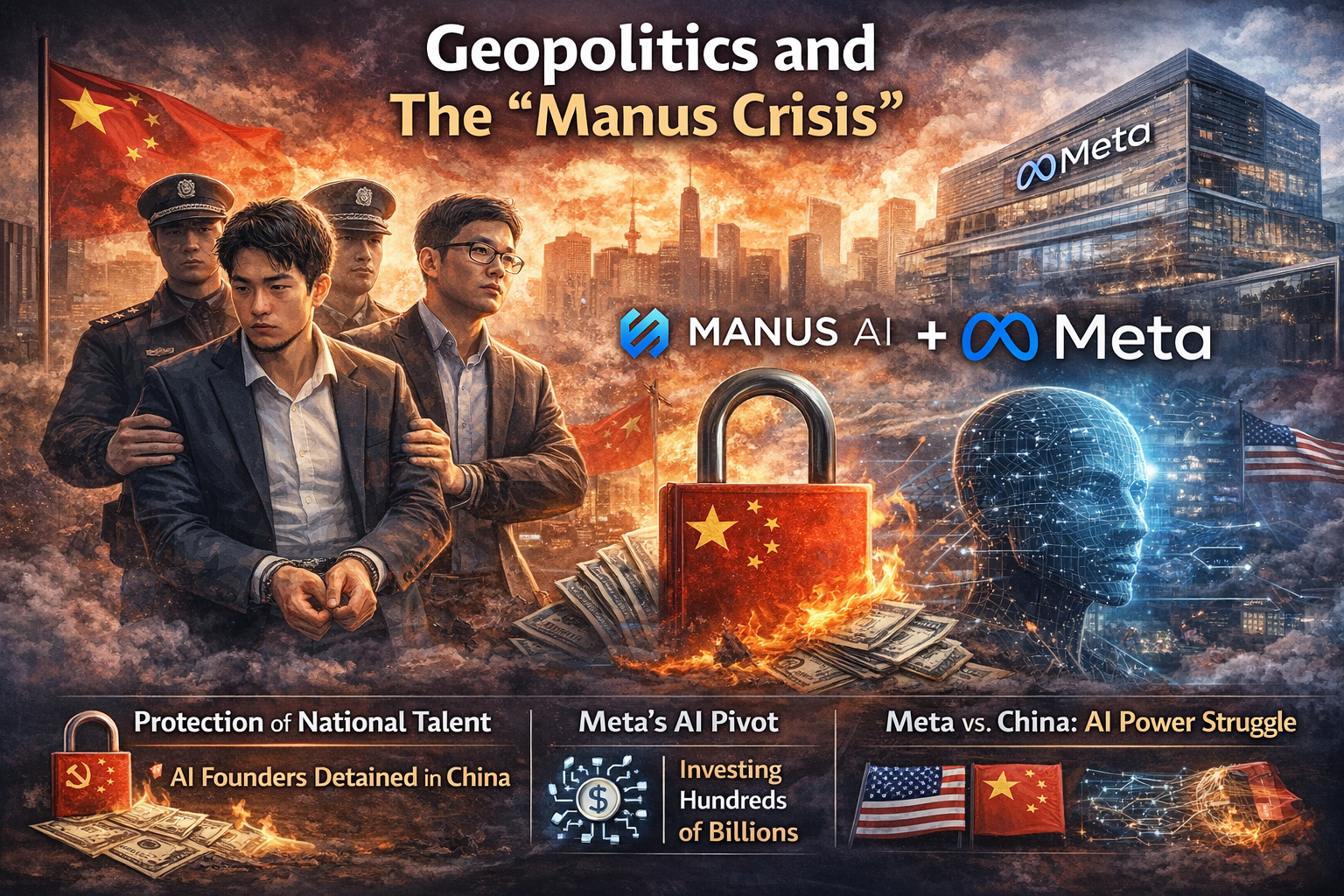
The geopolitical tension surrounding AI has reached a new peak with the "Manus Crisis".[28] China has barred the co-founders of the AI startup Manus—CEO Xiao Hong and Chief Scientist Ji Yichao—from leaving the country during a regulatory review of Meta’s acquisition of the firm.[28] Manus, which develops "digital employees" capable of research and automation, is valued at approximately $2 billion to $3 billion.[28] Chinese regulators are investigating whether the sale to Meta violates national investment and technology transfer rules.[28] Why this matters: The exit ban on AI researchers signals a shift where human talent is treated as a strategic national asset, similar to how advanced semiconductors are treated under export control laws.
This development occurs as Meta aggressively pivots its business model from social media toward becoming an "AI infrastructure layer".[29] Analysts estimate that Meta could invest nearly $600 billion in AI infrastructure by 2028, significantly scaling back its metaverse ambitions in favor of generative AI and automated advertising tools.[29] The company is reportedly aiming for near-fully automated advertising by 2026, where brands can upload a product image and let the AI handle the entire creative and targeting cycle.[29] Why this matters: Meta’s "all-in" bet on AI infrastructure suggests that the future of social platforms is not about the "metaverse," but about the monetization of attention through hyper-automated, agent-driven marketing.
Agency | Action / Framework | Objective |
|---|---|---|
US Administration | National AI Legislative Framework | Federal preemption of state AI laws to boost innovation |
China NDRC | Review of Meta-Manus Acquisition | Prevention of strategic tech flight to US giants |
European Commission | EU Digital Omnibus / AI Act | Balancing competitiveness with strict risk-based regulation |
NY AI Oversight | 72-Hour Incident Reporting | Mandatory transparency for "critical harm" events |
The United States is countering these international movements with a new "National AI Legislative Framework".[30, 32] This framework explicitly calls for federal preemption of state laws to avoid a "patchwork" of regulations that might hinder domestic innovation.[30, 32] It also suggests that training AI models on copyrighted material should be protected, while simultaneously calling for stricter protections for children and a "sunset" of Section 230 for AI-generated content.[32] Why this matters: The U.S. is prioritizing a unified national strategy to maintain its global lead in AI, even at the cost of overriding state-level consumer and privacy protections.
Scientific Breakthroughs and "Precision AI"
While much of the day's news is focused on commerce and power, AI is also delivering significant breakthroughs in the natural and medical sciences.[33, 34] In a study published in npj Climate and Atmospheric Science, researchers introduced a hybrid approach that combines AI with probabilistic modeling to revolutionize seasonal climate forecasting.[33] Traditional models were computationally expensive and limited in scale; the new AI-driven approach allows for more accurate predictions months in advance, which is critical for global agriculture and disaster management.[33] Why this matters: The integration of AI into physical sciences is moving beyond simple data processing to "hybrid modeling," where the AI understands the underlying physical laws of the atmosphere.
In oncology, the 2026 ASCO Gastrointestinal Cancers Symposium highlighted three AI-enabled analyses that identify "context-dependent biomarkers" in colorectal cancer.[34] These studies use AI to integrate multiomics data—including spatial transcriptomics and microbiome profiling—to reveal how ancestry and social determinants influence disease progression in young Hispanic/Latino patients.[34] The AI was able to simplify complex, multidimensional datasets to show that early-onset tumors have unique pathway activations that differ from late-onset disease.[34] Why this matters: AI is finally enabling "true" precision medicine by accounting for the clinical and sociodemographic context of the patient, rather than searching for universal prognostic markers.
The OpenAI Foundation has also committed $1 billion toward life sciences and curing diseases over the next year.[35] Led by co-founder Wojciech Zaremba, the foundation will focus on mapping disease pathways and identifying biomarkers for clinical trials.[35] This move is part of a broader "AI Resilience" program that also addresses biosecurity and the impact of AI on youth.[35] Why this matters: The separation of OpenAI’s "foundation" work from its "frontier" commercial work allows the company to pursue high-risk, high-reward medical research that would be difficult to justify under a traditional venture-backed model.
Market Sentiment: The Rotation into "AI-Plus"

The financial markets are reflecting these strategic shifts, with investors beginning to rotate out of "pure-play" AI stocks and into "AI-plus" companies—those that have significant non-AI businesses to buffer against volatility.[36] While NVIDIA remains the dominant force, analysts are predicting that the "winners of 2026" will be players like Apple, Microsoft, and Amazon, who have successfully integrated AI into their broader services.[36, 37] Apple, in particular, is seeing a resurgence as "Apple Intelligence" drives record-breaking service growth across its 2.5 billion active devices.[36, 37] Why this matters: The market is moving away from "AI hype" and toward "AI earnings," where the most valuable companies are those that can use AI to widen their existing competitive moats.
Meta’s decision to grant executive stock options for the first time since 2012 is a direct response to this intensifying race for talent and valuation.[38, 39] For these packages to vest, Meta must achieve "massive future success," with market cap milestones that reach as high as $9 trillion.[38] This aggressive incentive structure highlights the pressure on big tech leaders to not only develop AI but to dominate the entire global infrastructure layer.[39] Why this matters: The scale of these incentives suggests that the industry believes we are still in the early stages of the most significant wealth creation event in history, with the "endgame" valuation of the leading AI powerhouse expected to dwarf the current tech giants.
- OpenAI pulls the plug on Sora, the viral AI video app that sparked ..., https://www.gpb.org/news/2026/03/25/openai-pulls-the-plug-on-sora-the-viral-ai-video-app-sparked-deepfake-concerns
- OpenAI Shuts Down Sora - Seedance2ai.online Offers Seedance 2.0 as Immediate Alternative for Displaced AI Video Creators, https://www.accessnewswire.com/newsroom/en/computers-technology-and-internet/openai-shuts-down-sora-seedance2ai.online-offers-seedance-2.0-as-1151469
- Scaling AI for everyone | OpenAI, https://openai.com/index/scaling-ai-for-everyone/
- OpenAI to acquire Promptfoo, https://openai.com/index/openai-to-acquire-promptfoo/
- OpenAI reaches deal to deploy AI models on U.S. Department of War classified network, https://maaal.com/en/news/details/openai-reaches-deal-to-de/
- Our agreement with the Department of War | OpenAI, https://openai.com/index/our-agreement-with-the-department-of-war/
- OpenAI and US Department of Defense Agree to Terms for AI Deployment in Military Settings | Goodmans LLP, https://www.goodmans.ca/insights/post/goodmans-tech-blog/openai-and-us-department-of-defense-agree-to-terms-for-ai-deployment-in-military-settings
- Does the Anthropic–Pentagon feud mean the end of responsible AI? | The TechTank Podcast | Brookings, https://www.brookings.edu/articles/does-the-anthropic-pentagon-feud-mean-the-end-of-responsible-ai-the-techtank-podcast/
- OpenAI details layered protections in US defence department pact | The Straits Times, https://www.straitstimes.com/world/united-states/openai-details-layered-protections-in-us-defence-department-pact
- Google DeepMind teams up with Agile Robots for AI robotics push ..., https://seekingalpha.com/news/4568275-google-deepmind-teams-up-with-agile-robots-for-ai-robotics-push
- Google DeepMind launches first robotics accelerator for European startups, https://www.edtechinnovationhub.com/news/google-deepmind-launches-first-robotics-accelerator-for-european-startups
- Google DeepMind Accelerator, https://deepmind.google/models/gemini-robotics/accelerator/
- Beating Large Models? Google's Strongest Lightweight Model ..., https://news.aibase.com/news/26527
- Gemini 3.1 Flash-Lite: Built for intelligence at scale, https://blog.google/innovation-and-ai/models-and-research/gemini-models/gemini-3-1-flash-lite/
- Gemini 3.1 Flash Lite 2026 Features: Beginner's Checklist - VERTU® Official Site, https://vertu.com/guides/gemini-3-1-flash-lite-2026-features-beginners-checklist/
- Gemini 3.1 Flash-Lite Preview - Google AI for Developers, https://ai.google.dev/gemini-api/docs/models/gemini-3.1-flash-lite-preview
- Gemini 3.1 Flash-Lite | Generative AI on Vertex AI - Google Cloud Documentation, https://docs.cloud.google.com/vertex-ai/generative-ai/docs/models/gemini/3-1-flash-lite
- NVIDIA Ignites the Next Industrial Revolution in Knowledge Work With Open Agent Development Platform, https://nvidianews.nvidia.com/news/ai-agents
- Nvidia GTC 2026: Nvidia's hardware strategy goes beyond GPU in ..., https://www.constellationr.com/insights/news/nvidia-gtc-2026-nvidias-hardware-strategy-goes-beyond-gpu-ai-inference-pivot
- Enterprise AI in Action: Insights from GTC 2026, San Jose | ASUS Pressroom, https://press.asus.com/blog/enterprise-ai-insights-gtc-2026-asus/
- Gap Becomes First Retailer To Launch AI Checkout In Google Gemini - MediaPost, https://www.mediapost.com/publications/article/413783/gap-becomes-first-retailer-to-launch-ai-checkout-i.html
- Gap Teams With Google for Agentic Clothing Shopping - PYMNTS.com, https://www.pymnts.com/artificial-intelligence-2/2026/gap-teams-with-google-for-agentic-clothing-shopping/
- GAP PIONEERS CHECKOUT OPTION WITHIN GOOGLE'S GEMINI AS FIRST MAJOR FASHION BRAND - CNBC | Intellectia.AI, https://intellectia.ai/news/stock/gap-pioneers-checkout-option-within-googles-gemini-as-first-major-fashion-brand--cnbc
- Gap Dives into AI Commerce with Checkout on Google Gemini and New Fit Guidance Tech, https://www.retailtouchpoints.com/news/gap-dives-into-ai-commerce-with-checkout-on-google-gemini-and-new-fit-guidance-tech/618130/
- Anthropic's Claude can now use your computer like a human: Will it ..., https://indianexpress.com/article/technology/artificial-intelligence/anthropic-claude-computer-use-ai-agents-openclaw-10598605/
- Anthropic Extends Claude Code Into Messaging Apps, Challenging OpenClaw's Lead, https://devops.com/anthropic-extends-claude-code-into-messaging-apps-challenging-openclaws-lead/
- Anthropic takes on OpenClaw with new Claude Code text feature - Silicon Republic, https://www.siliconrepublic.com/machines/anthropic-takes-on-openclaw-with-new-claude-code-text-feature
- China bars Manus co-founders from leaving country amid Meta deal ..., https://www.investing.com/news/stock-market-news/china-bars-manus-cofounders-from-leaving-country-as-it-reviews-sale-to-meta-ft-reports-4578993
- Meta enters 2026 as an AI-driven advertising and infrastructure ..., https://communicateonline.me/news/meta-enters-2026-as-an-ai-driven-advertising-and-infrastructure-powerhouse-report/
- 2026 AI Laws Update: Key Regulations and Practical Guidance - Gunderson Dettmer, https://www.gunder.com/en/news-insights/insights/2026-ai-laws-update-key-regulations-and-practical-guidance
- Deregulating artificial intelligence will not boost EU tech markets - Bruegel, https://www.bruegel.org/first-glance/deregulating-artificial-intelligence-will-not-boost-eu-tech-markets
- Administration Releases National AI Legislative Framework, https://www.conference-board.org/research/CED-Newsletters-Alerts/administration-releases-national-AI-legislative-framework
- AI meets climate forecasting: a new era for seasonal predictions - eo science for society, https://eo4society.esa.int/2026/03/25/ai-meets-climate-forecasting-a-new-era-for-seasonal-predictions/
- Three AI-Enabled Analyses Highlight Context-Dependent Biomarkers in Early-Onset Colorectal Cancer - The ASCO Post, https://ascopost.com/issues/march-25-2026/three-ai-enabled-analyses-highlight-context-dependent-biomarkers-in-early-onset-colorectal-cancer/
- Update on the OpenAI Foundation, https://openai.com/index/update-on-the-openai-foundation/
- Prediction: The Artificial Intelligence (AI) Stocks That Win in 2026 Won't Be the Same Ones That Won in 2025 | The Motley Fool, https://www.fool.com/investing/2026/03/25/prediction-the-artificial-intelligence-ai-stocks-t/
- The Zacks Analyst Blog Highlights Apple, Meta Platforms, Chevron, Investors Title and AmeriServ Financial - March 25, 2026, https://www.zacks.com/stock/news/2889183/the-zacks-analyst-blog-highlights-apple-meta-platforms-chevron-investors-title-and-ameriserv-financial
- Meta Platforms raises top executive pay with stock options amid intensifying AI race, https://seekingalpha.com/news/4568272-meta-platforms-raises-top-executive-pay-with-stock-options-amid-intensifying-ai-race
- As Mark Zuckerberg's Meta announces stock options to its key leaders, company 'makes it clear': These pay packages will not be realized unless Meta … - The Times of India, https://timesofindia.indiatimes.com/technology/tech-news/as-mark-zuckerbergs-meta-announces-stock-options-to-its-key-leaders-company-makes-it-clear-these-pay-packages-will-not-be-realized-unless-meta-/articleshow/129791734.cms
Recommended AI tools

Claude
Conversational AI
Your trusted AI collaborator for coding, research, productivity, and enterprise challenges

Suno AI
Music Generation
Make any song you can imagine

Notebook LLM
Productivity & Collaboration
Turn complexity into clarity with your AI-powered research and thinking partner
AutoGPT
Productivity & Collaboration
Build, deploy, and manage autonomous AI agents – automate anything, effortlessly.

Grammarly
Writing & Translation
Your AI writing partner for work

Microsoft Copilot
Conversational AI
Your everyday AI companion for work, learning, and creativity
About the Author

Albert Schaper is a co-founder of Best-AI.org. He focuses on product strategy, AI adoption, practical tool selection, and educational content that helps users compare AI products with clearer context.
More from AlbertWas this article helpful?
Found outdated info or have suggestions? Send us a note.